
User-Generated Reviews: Why 93% of Shoppers Trust Them More Than Ads

User-generated reviews matter for community strategy because they carry more purchase influence than anything a brand produces itself: in a 2023 survey of 8,153 U.S. shoppers, PowerReviews found that 93% say ratings and reviews affect whether they buy a product. That means the reviews, photos, and stories your users already create inside your app function as a demand-generation channel, not just social proof. A community strategy built to capture and surface that content turns everyday users into your most credible sales force.
Why UGC and Reviews Matter Now More Than Ever
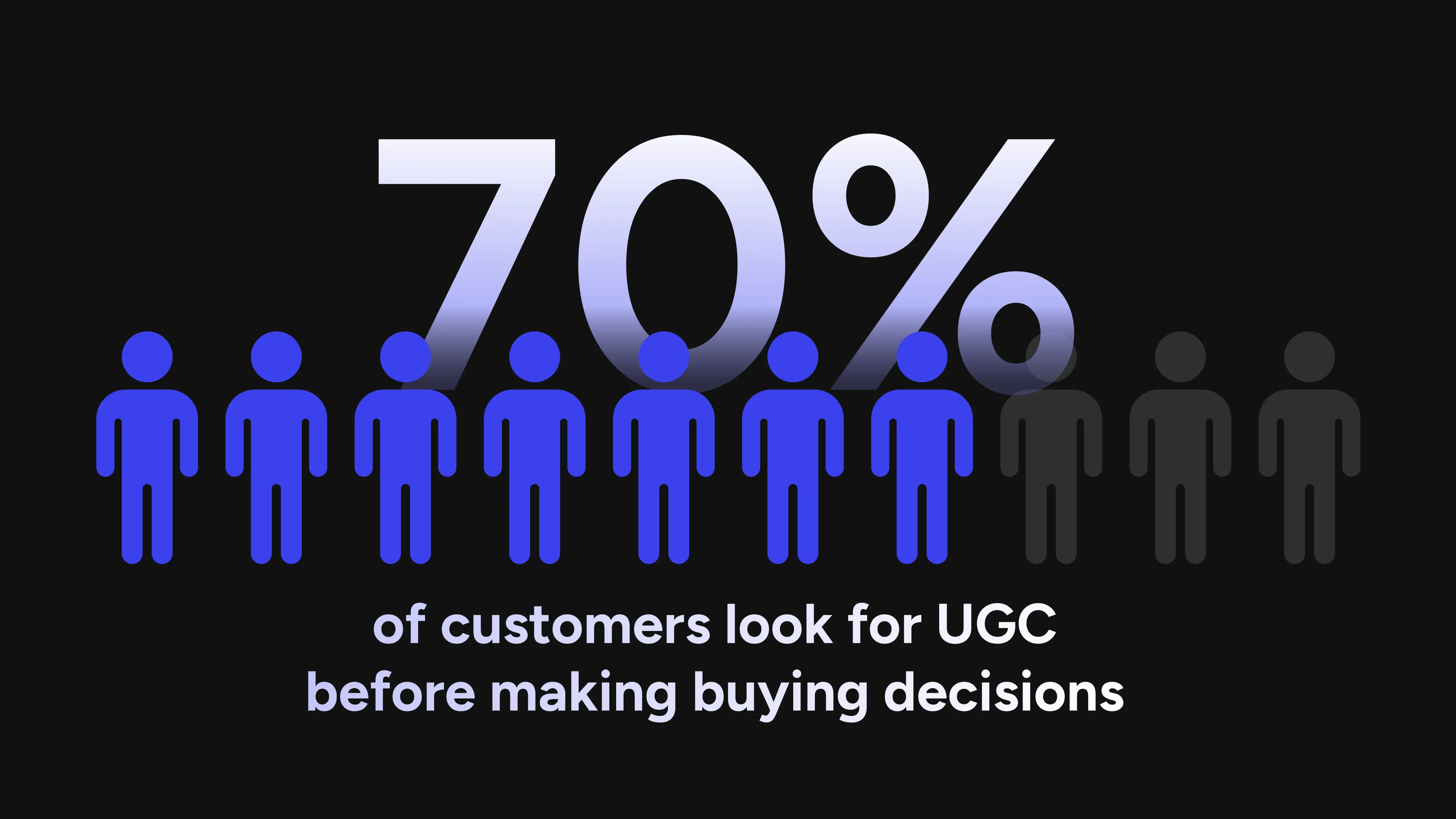
UGC and reviews matter now because trust in brand messaging has declined while trust in peer content keeps climbing. Shoppers no longer take a brand's word for it. They look for evidence from people who already bought, used, and lived with the product, and that evidence increasingly decides what gets purchased.
| Finding | Source |
|---|---|
| 93% of shoppers say ratings and reviews affect whether they purchase a product | PowerReviews, 2023 (8,153 U.S. consumers) |
| 79% of online shoppers say user-generated photos and videos from other consumers highly impact their purchasing decisions | Stackla, 2021 (2,042 consumers, US/UK/Australia) |
Three shifts explain why this influence keeps growing:
- Authenticity has become the deciding factor. With more brand-produced content in every feed, buyers increasingly filter for signals they cannot fake, like real photos, specific details, and unscripted opinions from other users.
- Reviews front-load the buying decision. Most shoppers now read reviews before they reach a product page, using them to shortlist options rather than confirm a choice they already made.
- Peer content compounds. Every review, photo, or comment a user contributes becomes evidence the next visitor can act on, so the value of your community's content grows with participation instead of resetting with every campaign.
So what does that mean for enterprise community and growth teams? If you invest only in one-way brand broadcasting, you are missing the far more powerful peer-to-peer influence channel that in-app community infrastructure is built to capture.
This is a structural shift, not a passing trend. Digital products that once relied on outbound marketing to earn attention now compete on whether shoppers can find credible proof, fast, inside the product itself. A brand that only publishes its own content is asking users to take its word for it. A brand that surfaces reviews, photos, and stories from other users is letting the product make the case on its own. Community and growth teams that treat UGC as a side effect of good service, rather than a channel to actively build, are leaving that influence on the table.
How Reviews and UGC Drive Community Growth and Revenue
Reviews and UGC drive community growth and revenue by doing three things at once: lowering the friction to purchase, turning users into active contributors, and compounding the value of your existing marketing and product investment.
| Driver | What happens inside your community | Business outcome |
|---|---|---|
| Trust | Users see peers share real experiences | Lower hesitation, higher purchase confidence |
| Participation | Users post reviews, photos, and questions | A self-reinforcing loop of content and engagement |
| Conversion | Reviews and UGC surface where users decide | Higher conversion and lifetime value |
1) Build Trust and Lower Friction
When new or existing users see peers sharing real experiences, such as reviews, photos, and comments, they get more confident. That means less hesitation and a higher likelihood to purchase or engage. With 93% of shoppers saying ratings and reviews affect their purchase decision, the users inside your community effectively become micro-influencers for your brand, at no incremental media cost. A single detailed review from a user, written in their own words, can do more to move a hesitant buyer than another round of polished brand copy.
2) Amplify Participation and Advocacy
When you give users a space to share reviews, ask questions, and post photos and videos, you create a virtuous loop: users share, newcomers believe, newcomers engage, and they share too. This peer-driven content fuels your owned community platform, reduces dependence on paid acquisition, and supports broader growth without adding to your ad spend. This is the mechanism behind what marketers call community-based marketing, where the users themselves become the acquisition channel. Each user who contributes also becomes more invested in the brand itself, because they now have a visible stake in the community they helped build.
3) Boost Conversion and Lifetime Value
UGC does not just influence a single purchase decision. It compounds conversion and value over time. When your community is rich with reviews, stories, and user content, that content keeps working on every future visit, activating a multiplier on your existing marketing and product efforts rather than delivering a one-time lift. A product page backed by dozens of user reviews continues converting long after the campaign that first drove traffic to it has ended, which is what makes UGC a durable asset rather than a short-lived tactic.
Why This Matters for Enterprise Community Managers
This matters for enterprise community managers because owned community spaces are the only channel where you control both the supply of UGC and how it gets moderated and surfaced. At enterprise scale, that control is what separates a strategy from a hope that positive reviews happen to show up somewhere useful.
- Owned spaces give you direct access. In-app forums, user profiles, and brand-hosted community groups put reviews and UGC inside your infrastructure instead of an external platform where you have no control over visibility, algorithm changes, or data access. When a review lives on a third-party site, you cannot decide where it appears, how long it stays visible, or whether it ever reaches the shopper who needed to see it.
- Contribution turns passive users into stakeholders. Encouraging reviews, posts, and images turns passive users into active contributors. They feel valued and heard, and in return their content influences others, driving both engagement and conversion. Over time, this shifts the relationship from a company talking at an audience to a community of users who have a reason to keep coming back.
- Moderation protects the trust you are building. UGC and reviews only build confidence if they are credible, which means a moderation layer that filters spam and abuse without stripping out the honest, sometimes critical, feedback that makes reviews believable in the first place. A community that only ever shows five-star praise reads as curated, not authentic, and shoppers notice the difference.
- Measurement proves the value. As UGC increases, track content volume, review counts, conversion lift on review-rich pages, community growth, and referral rate from community to purchase. For enterprise teams, these inputs can also feed into marketing mix modeling to understand how community and peer-driven content contribute alongside other channels to overall business outcomes, which makes it easier to defend continued investment in community infrastructure at budget time.
What You Can Do Right Now
You can start building a UGC-driven community strategy today with five concrete steps, starting with an audit of what you already have.
- Audit your review and community content. How many user reviews, photos, and videos exist for your key products or experiences? Are they visible inside your community hub, or buried on a separate reviews tab that most users never open?
- Make contribution frictionless. Give users tools to submit reviews or UGC easily: mobile uploads, community prompts, and light incentives for sharing real experiences. The easier it is to contribute in the moment, right after a purchase or a positive interaction, the more content you collect.
- Feature user content prominently. Surface it on your website, in-app, and in emails. Highlight user stories, photos, and \"how I use this\" posts instead of only brand-produced imagery, so new visitors see evidence from people like them before they see a sales pitch.
- Integrate the community and purchase path. When a user reads a peer review inside your community, make it easy for them to purchase or engage further without leaving the experience. Every extra step between reading a review and acting on it is a chance for that influence to be lost.
- Measure and iterate. Track how review-rich pages perform against non-review pages, and how community users convert or return compared to non-users. Use that data to justify further investment in your community strategy, and to identify which product areas would benefit most from a push to collect more UGC.
The Bottom Line
If 93% of shoppers say reviews and ratings affect what they buy, your community is not a \"nice to have.\" It is a critical lever in your growth stack. Communities that enable reviews, peer content, and user storytelling build trust, conversion, and value at the same time, and that value compounds: more contributors produce more evidence, more evidence lowers hesitation for the next visitor, and a lower-friction path to purchase brings in more users who go on to contribute themselves.
social.plus provides the in-app community infrastructure to bring reviews, peer-to-peer content, and community interaction under your brand's roof, so you control the experience, the data, and the growth that follows. That ownership is what turns UGC from a one-time marketing tactic into a long-term advantage competitors relying on external platforms cannot easily copy.
Frequently Asked Questions
What percentage of consumers trust user-generated content?
93% of shoppers say ratings and reviews affect whether they purchase a product, based on a 2023 PowerReviews survey of 8,153 U.S. consumers. A separate 2021 Stackla survey of 2,042 consumers found that 79% say user-generated photos and videos from other shoppers highly impact their purchasing decisions, more than brand-created or influencer content.
How does UGC influence purchase decisions?
UGC influences purchase decisions by giving shoppers evidence they trust more than brand messaging: real photos, specific details, and honest reviews from people who already bought the product. That evidence lowers hesitation earlier in the buying journey, and it keeps influencing every future visitor who encounters it, not just the user who created it.
How do you build a UGC-driven community strategy?
Building a UGC-driven community strategy starts with giving users an owned space to create and see reviews, photos, and comments, then making contribution frictionless and featuring that content where buying decisions happen. From there, add moderation to protect credibility, and track metrics like review volume and conversion lift to prove the strategy is working.
Should user-generated reviews live in an owned community or a third-party platform?
Reviews and UGC create more value inside a community you control, because you decide how content is moderated, surfaced, and connected to the purchase path. On an external platform, visibility and access depend on rules and algorithms you do not own. Owned in-app community infrastructure keeps the audience relationship, engagement data, and conversion opportunity with your brand instead.
Ready to turn reviews and everyday user activity into a growth channel you control? Talk to our team about building UGC-driven community infrastructure into your app.