5 Best Community Infrastructure Platforms for Enterprise Apps (2026)
Enterprise apps operate at a scale where community isn't a feature you add. It's infrastructure you architect. Millions of users generating content, conversations, and interactions across regions, platforms, and regulatory environments require community systems that are built for that depth of complexity from the ground up. The SDKs, APIs, and UI components powering those experiences need to handle volume without degradation, govern content across jurisdictions, and give operational teams the tools to manage what a large, active user base produces. Building that infrastructure internally is a significant and ongoing investment in engineering, security, compliance, and moderation tooling that compounds over time. Community infrastructure platforms provide an alternative: production-ready social capabilities with the governance, reliability, and scale that enterprise applications demand, so engineering teams can focus on the product rather than maintaining the systems underneath it. This guide compares five platforms, what each covers, and how to choose the right foundation for an enterprise app.
What Is a Community Infrastructure Platform?
A community infrastructure platform provides SDKs, APIs, pre-built UI components, and backend services for embedding social and community features inside an application at enterprise scale. These platforms typically cover real-time chat, social feeds, content moderation, user management, analytics, and compliance capabilities, and are designed to meet the governance, security, and reliability requirements that enterprise applications demand.
The distinction matters because it shapes what your team owns and what the platform handles.
Community infrastructure platforms provide the full backend and frontend tooling for in-app community features inside your app. They handle the infrastructure, often as white-label community platforms, so your team focuses on the product experience. They differ from point solutions, which cover one capability like chat or video but leave the rest of the community stack to your team, and from internal builds, which offer full architectural control but require continuous engineering investment in infrastructure, security, compliance, and moderation that grows alongside the user base.
At enterprise scale, community infrastructure goes beyond social SDKs for engagement to encompass compliance, governance, and operational requirements that come with millions of active users. It's about what the platform does with the volume, complexity, and operational requirements that come with millions of active users across a large application.
What to Look for in a Community Infrastructure Platform for Enterprise
Before evaluating specific platforms, it helps to know what separates one from another at the enterprise level. These are the criteria that matter most when choosing infrastructure your product will depend on.
Compliance and security certifications
SOC 2, HIPAA, ISO 27001, and GDPR are the baseline for enterprise procurement. Some platforms also cover PIPEDA, COPPA, and CCPA. Beyond certifications, evaluate encryption standards, access controls, audit logging, and data governance capabilities.
Scalability and infrastructure reliability
What uptime SLA does the platform guarantee? How does performance hold at enterprise-scale concurrent usage? Auto-scaling, global distribution, and data redundancy determine whether the platform handles growth without architectural changes on your side, protecting your retention rate.
Governance and moderation at scale
Enterprise apps need moderation that operates at the volume their user base generates. AI-powered content moderation, configurable pipelines, role-based governance, and admin workflows keep the community safe without requiring a proportional increase in human moderators.
Feature completeness versus point solutions
Does the platform cover the full community stack, or does your team assemble capabilities from multiple vendors? Each additional vendor adds procurement overhead, integration complexity, and another SLA to manage. A platform that covers chat, feeds, moderation, analytics, and more in one system reduces that surface area.
Operational tooling for non-technical teams
Enterprise community infrastructure isn't only used by engineers. Community managers, admins, and business stakeholders need dashboards, moderation interfaces, and analytics they can act on directly. The best platforms give operational teams autonomy without creating engineering dependencies for every decision.
Total cost of ownership versus internal build
Internal builds carry ongoing costs beyond initial development: infrastructure maintenance, security patching, compliance upkeep, moderation tooling, and the opportunity cost of engineering time diverted from product development. Platforms that cover more of the stack reduce that ongoing investment.
The right community infrastructure platform for enterprise depends on how much of the stack you need covered, what compliance and governance requirements your organization has, and whether the platform reduces total cost of ownership compared to maintaining the infrastructure yourself.
5 Best Community Infrastructure Platforms for Enterprise Apps (2026)
social.plus: Best for enterprise apps that need the full community stack with built-in governance and analytics
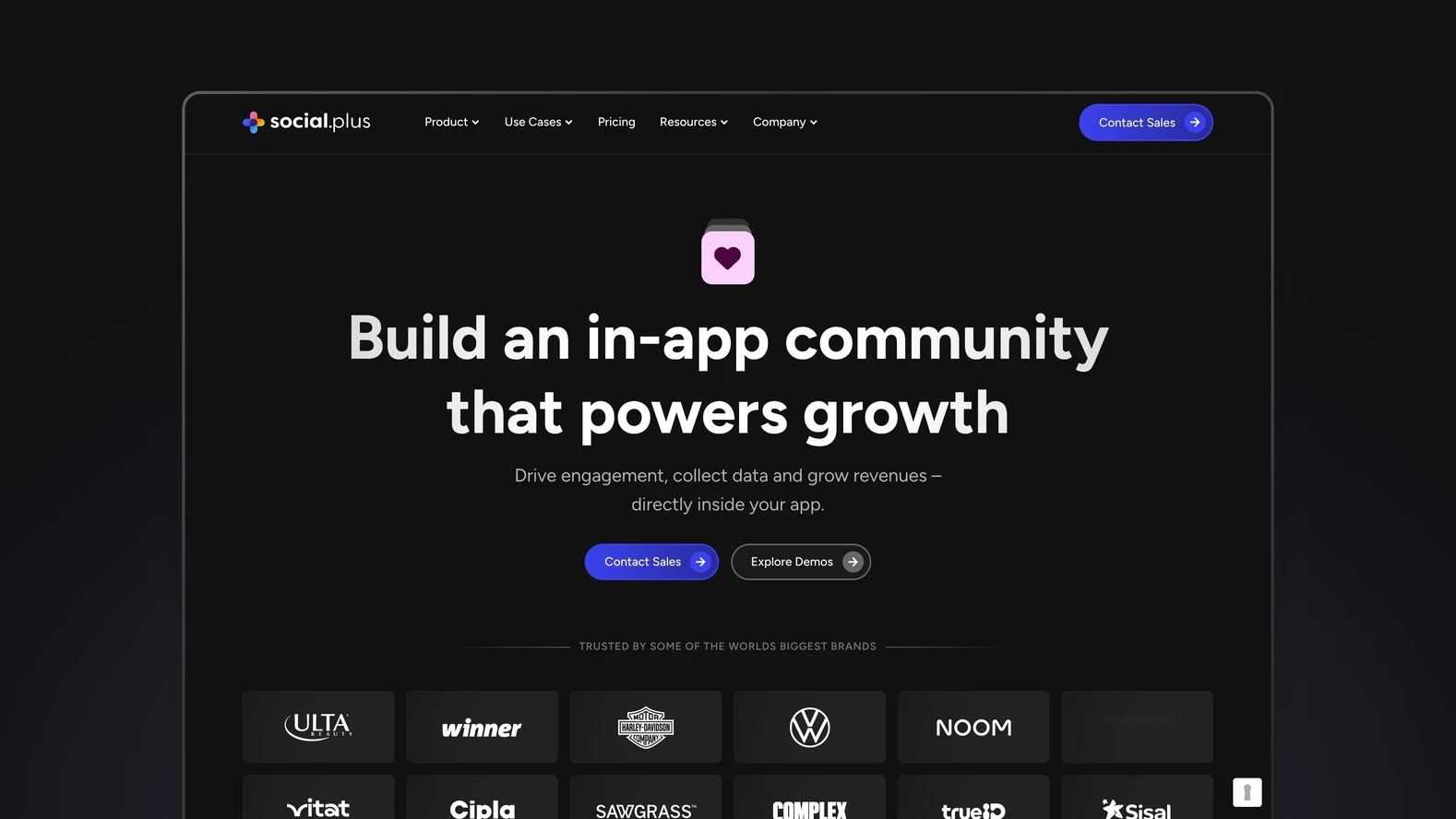
social.plus provides SDKs, APIs, and UIKit for embedding community features inside enterprise applications: chat, social feeds, stories, events, live streaming, moderation, analytics, and monetization. The platform supports iOS, Android, Web, React Native, and Flutter with pre-built, customizable UI components across all five platforms. SOC 2, GDPR, and ISO 27001 compliant, with enterprise SLA guarantees and infrastructure built for scale and security.
What makes social.plus relevant for enterprise is that the governance, moderation, and analytics layers are built into the same system as the community features. AI-powered moderation scales with content volume. Analytics dashboards give community managers and business stakeholders direct visibility into engagement, content performance, and community health. Role-based access controls, audit capabilities, and compliance features are part of the platform architecture. The result is community infrastructure where the operational tooling grows alongside the community, and teams across the organization can manage what a large user base produces without depending on engineering for every operational decision.
Key strengths:
- Full community stack in one platform with a shared data layer: chat, feeds, stories, events, live streaming, moderation, analytics, and monetization all working as a unified system
- SOC 2, GDPR, and ISO 27001 compliant with enterprise SLA guarantees, encryption, and infrastructure designed for large-scale concurrent usage across global markets
- AI-powered moderation with configurable pipelines and admin workflows that scale governance alongside community growth
- Analytics and operational dashboards built for community managers and admins, reducing engineering dependencies for day-to-day community operations
Considerations:
- The platform is designed for enterprise apps where community is a strategic layer of the product. Teams evaluating a single capability like chat alone may find a focused point solution faster.
- Enterprise teams benefit from planning integration scope upfront. Starting with one feature area and expanding is supported, but understanding the full platform early helps align internal stakeholders on long-term architecture.
Pricing: Contact for pricing. Enterprise plans scale with usage and scope.
Best fit: Enterprise product and engineering teams who want one community infrastructure platform that covers features, governance, moderation, and analytics, without assembling separate vendors or building operational tooling from scratch.
Stream: Best for enterprise engineering teams that want composable community building blocks
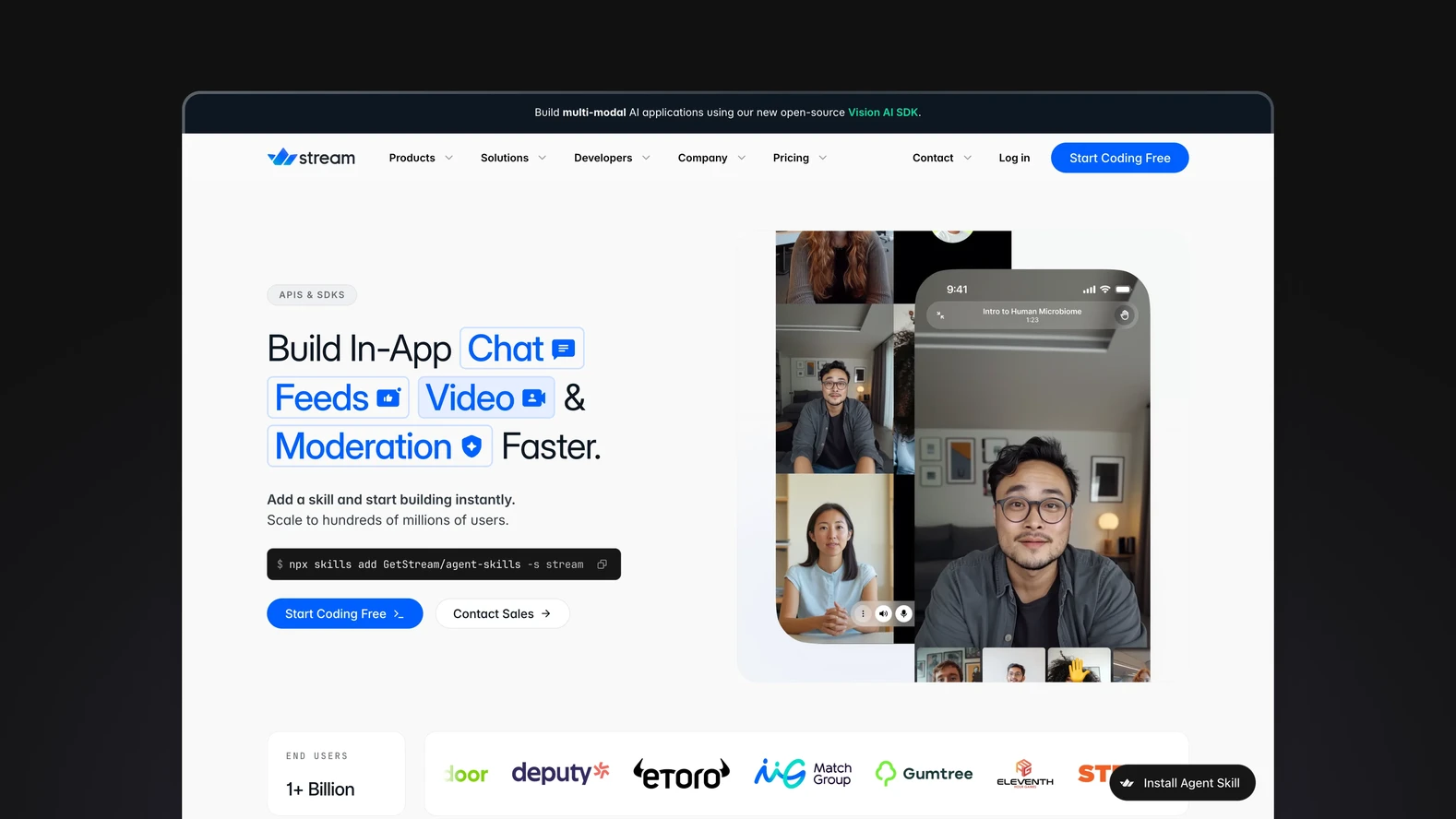
Stream provides Chat, Activity Feeds, and Video as separate infrastructure products, each with native SDKs and UI component libraries. The platform includes SOC 2, ISO 27001, HIPAA, and GDPR compliance and AI Moderation as a dedicated product.
Key strengths:
- Chat, Activity Feeds, and Video as composable products that enterprise teams adopt independently based on what the product requires
- SOC 2, ISO 27001, HIPAA, and GDPR compliance with dedicated security documentation
- AI Moderation that integrates across Chat and Feeds for content governance
- Thorough documentation and developer tooling that support enterprise engineering workflows
Considerations:
- Each community capability (Chat, Feeds, Video, Moderation) is a separate product with separate integration and pricing. Enterprise teams managing procurement across multiple products should evaluate the combined contract and integration scope early.
- Stream provides strong community infrastructure building blocks. Unified community analytics, operational dashboards for non-technical teams, and monetization capabilities are built by your team on top of Stream's products.
Pricing: Per-product pricing. Enterprise plans are custom with dedicated support.
Best fit: Enterprise engineering teams that want composable infrastructure products for specific community capabilities and have the internal capacity to assemble the broader community experience across separate products.
Sendbird: Best for enterprise apps where messaging infrastructure is the primary requirement
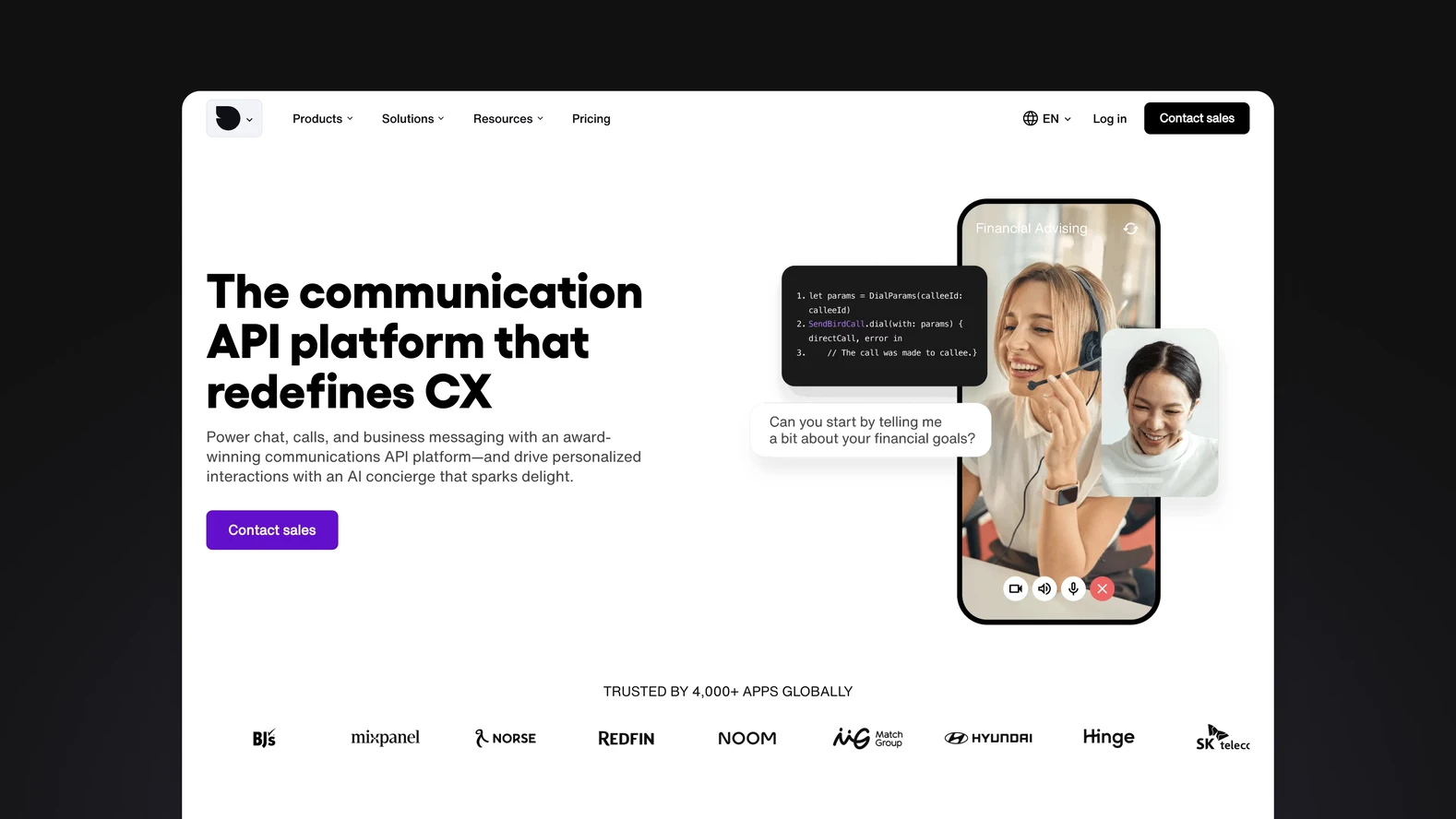
Sendbird provides Chat, Voice, Video, and Live Streaming SDKs with enterprise compliance and scale. UIKit components are available for React, SwiftUI, and Jetpack Compose. The platform includes SOC 2, HIPAA, ISO 27001, and GDPR compliance and an AI layer for conversational automation.
Key strengths:
- Enterprise compliance coverage across SOC 2, HIPAA, ISO 27001, and GDPR
- Chat infrastructure built for scale with supergroup channels supporting up to 20,000 concurrent users
- AI-powered conversational automation for enterprise customer engagement workflows
- UIKit components that reduce front-end development time for enterprise product teams
Considerations:
- Sendbird's enterprise strength is messaging infrastructure. Social feeds, content discovery, and broader community features beyond chat are outside the platform's scope. Enterprise teams building community across multiple social surfaces assemble those capabilities separately.
- The platform's roadmap is increasingly focused on AI-driven conversational CX. Enterprise teams whose community strategy centers on content and social engagement should evaluate whether the direction aligns with their requirements.
Pricing: Tiered plans through Enterprise. Enterprise includes custom pricing and dedicated support.
Best fit: Enterprise teams where messaging infrastructure is the primary community requirement and where compliance, scale, and AI-driven conversational automation are priorities.
CometChat: Best for enterprise apps that need chat infrastructure with multi-tenant support and deployment flexibility
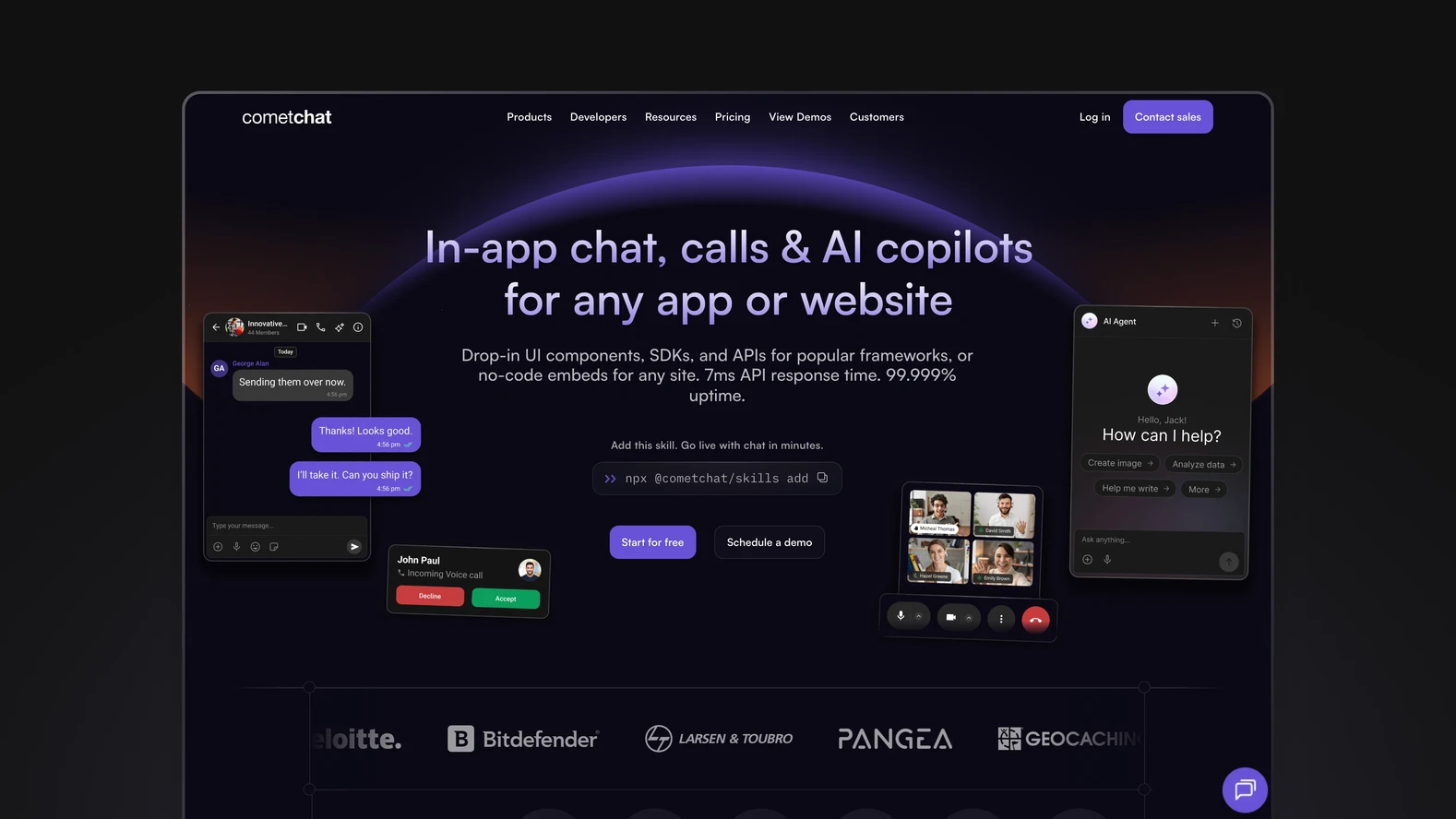
CometChat provides Chat and Voice/Video Calling SDKs with UIKits across React, React Native, Flutter, iOS, and Android. The platform includes multi-tenant infrastructure, on-prem deployment options, moderation and guardrails, analytics and insights, and compliance coverage across ISO, HIPAA, SOC 2, GDPR, PIPEDA, and COPPA.
Key strengths:
- Multi-tenant infrastructure that lets enterprise teams run multiple brands, communities, or customer segments from a single backend with isolated logic, moderation, and branding per tenant
- On-prem deployment option for enterprise teams operating in environments where cloud-only solutions don't meet regulatory or policy requirements
- Moderation and guardrails with context-aware content safety, plus analytics and insights dashboards for conversation health and engagement monitoring
- Compliance coverage across ISO, HIPAA, SOC 2, GDPR, PIPEDA, and COPPA with 99.999% uptime SLA
Considerations:
- CometChat's enterprise infrastructure centers on chat, calling, and AI agents. Social feeds, stories, content sharing, and broader community features beyond conversation are outside the platform's scope. Enterprise teams needing a full community stack build those capabilities separately.
- MAU-based pricing with overage charges on standard plans means enterprise teams should model costs at projected scale. The Enterprise tier offers custom pricing with zero overages.
Pricing: Tiered MAU-based pricing. Enterprise includes custom pricing, zero overages, and dedicated support.
Best fit: Enterprise teams that need chat infrastructure with multi-tenant support, on-prem deployment, and broad compliance coverage, particularly in regulated industries where deployment flexibility is a requirement.
PubNub: Best for enterprise teams that want maximum architectural control over community infrastructure

PubNub provides real-time infrastructure SDKs built on a publish/subscribe model, covering messaging, presence detection, serverless Functions, and file sharing. The platform includes Illuminate for real-time analytics and decisioning, BizOps Workspace for admin management, and compliance coverage across GDPR, HIPAA, SOC 2 Type 2, SOC 3, and ISO 27001.
Key strengths:
- Enterprise-grade real-time infrastructure with sub-100ms global latency, 99.999% uptime SLA, and unlimited concurrent users and channels
- Compliance coverage across GDPR, HIPAA, SOC 2 Type 2, SOC 3, and ISO 27001
- Illuminate and BizOps Workspace provide no-code analytics, decisioning, and admin tools that reduce the operational burden of managing custom-built community features
- Serverless Functions for custom logic at the edge, giving enterprise teams architectural flexibility without managing additional backend infrastructure
Considerations:
- PubNub is real-time infrastructure, not a community platform. Social feeds, user profiles, moderation workflows, content governance, and community UI are all built by your team. This gives enterprise teams maximum architectural control but requires significant and ongoing engineering investment.
- PubNub is most relevant for enterprise teams whose real-time needs extend beyond community into IoT, gaming, live events, or operational data streaming, where the same infrastructure serves multiple enterprise use cases.
Pricing: Enterprise plans are custom with dedicated support and SLA guarantees.
Best fit: Enterprise engineering teams that want full architectural control and are building community on top of proven real-time infrastructure, especially when the same infrastructure serves multiple enterprise use cases beyond community.
At-a-Glance Comparison
How to Choose the Right Community Infrastructure Platform for Enterprise
With five platforms covering different parts of the enterprise community stack, the decision comes down to five things.
How much of the community stack you need covered. If your enterprise app needs one capability like messaging, a focused platform covers that fast. If the community spans chat, feeds, content, moderation, and analytics, a full-stack platform means one vendor, one integration, and one SLA to manage instead of assembling and maintaining multiple products.
What your compliance and governance requirements are. Different platforms cover different certifications. Map your organization's requirements to what each platform provides. Beyond certifications, evaluate role-based access controls, audit logging, and data governance.
Whether you need deployment flexibility. Most platforms operate as cloud services. If your enterprise requires on-prem deployment or hybrid architectures, the list narrows. Evaluate this early since deployment models can be a hard constraint.
Total cost of ownership versus building internally. Internal builds require infrastructure maintenance, security patching, compliance upkeep, moderation tooling, and ongoing engineering. Platforms that cover more of the stack reduce that investment. Model the total cost at projected scale, including engineering time, before deciding.
How the platform scales with your growth. Enterprise apps grow. The platform should handle that growth without re-architecture. Evaluate uptime SLAs, auto-scaling capabilities, and pricing models at 2x and 10x your current scale.
The best community infrastructure platform for enterprise is the one that satisfies your governance and compliance requirements, covers enough of the stack to reduce total cost of ownership, and scales without forcing your team to re-architect.