6 Best White-Label Community Platforms for Apps (2026)
When users engage with community features inside your app, the experience should feel like your product, not like a third-party tool layered on top. White-label community platforms make this possible by providing SDKs, APIs, and UI components that embed directly into your application: fully branded, fully customizable, and invisible to the end user. Your users interact with your product, your brand owns the experience, and your team controls the data. But the platforms powering these experiences vary in how deeply they support that vision. Some ship pre-built components you can restyle to match your brand. Others provide raw APIs where every pixel is yours to design. The scope of what gets white-labeled also varies: some platforms cover the full community stack under your brand, while others handle one capability and leave the rest to your team. This guide compares six white-label community platforms, how each handles branding and customization, and how to choose the right foundation for your app.
What Is a White-Label Community Platform?
A white-label community platform provides SDKs, APIs, and UI components that allow teams to embed social and community features inside their own application under their own brand. The platform's infrastructure powers the experience, but end users only ever see the brand's product. No third-party branding, no external redirects, and no sign that an outside provider is involved.
The distinction matters because it determines how much of the community experience your brand controls.
White-label community platforms embed inside your app through native code. The features become part of your product, styled to match your design system, powered by a community SDK, and the data stays within your ecosystem. They differ from branded community platforms, where users interact in a third party's environment with that platform's branding visible, and from community infrastructure platforms that prioritize enterprise governance over branding control.
The range of what "white-label" covers varies. Some platforms ship pre-built UI components, similar to chat and social feed SDKs, that your team restyles to match the brand. Others provide headless APIs where the entire front-end experience is custom. The right approach depends on how fast your team needs to ship versus how custom the experience needs to be.
What to Look for in a White-Label Community Platform
Before evaluating specific platforms, it helps to know what separates one from another when white-label control is the priority. These are the criteria that matter most.
Branding and design control
Can your team restyle every component to match your app's design system? Look for custom theming, layout overrides, and component-level styling. The strongest white-label platforms make community features indistinguishable from the rest of your product.
Data ownership and control
White-label means your brand owns the experience, so your team should also own the data. Evaluate whether the platform provides data export, full API access to user and content data, and the ability to pipe engagement data into your own analytics infrastructure.
Customization depth
Beyond visual branding, can your team override default behaviors, build custom interaction flows, and extend the platform's functionality? Pre-built components get you to launch fast, while APIs let you build anything. The strongest white-label platforms offer both: components for speed and APIs for full control.
Feature scope under your brand
How much of the community experience can you white-label? Some platforms cover chat only. Others cover feeds, stories, events, live streaming, moderation, and analytics, all under your brand. The more features available as white-label, the more of your product's social experience you can ship without building from scratch.
Platform coverage
Your branded community experience needs to feel native across every platform your users are on. iOS, Android, Web, React Native, and Flutter coverage means the white-label experience is consistent across every surface.
Moderation and governance under your brand
When community features carry your brand, content quality reflects directly on your product. Moderation tools, content filtering, and admin workflows need to operate within the white-label experience, giving your team control over what appears under your name.
The right white-label community platform depends on how much design control your team needs, how many community features you want under your brand, and whether you need pre-built components for speed or APIs for full customization, making white-label options a strong choice among alternatives to Discord and Facebook Groups.
6 Best White-Label Community Platforms for Apps (2026)
social.plus: Best for apps that want the full community experience running natively under their brand
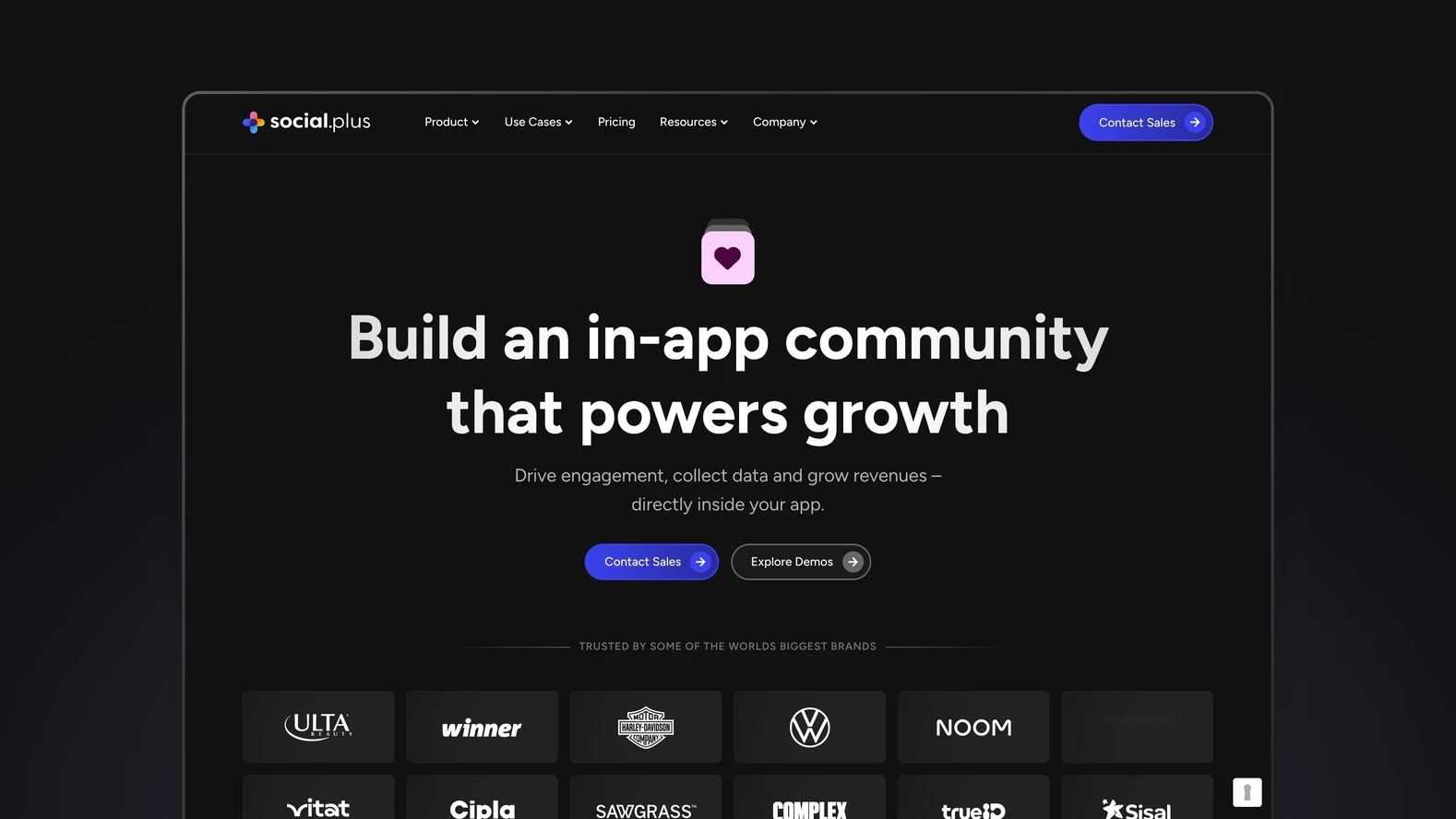
social.plus provides SDKs, APIs, and UIKit for embedding the full range of community features inside your application under your brand: chat, social feeds, stories, events, live streaming, moderation, analytics, and monetization. The platform supports iOS, Android, Web, React Native, and Flutter with pre-built, fully customizable UI components across all five platforms. SOC 2, GDPR, and ISO 27001 compliant.
social.plus is built around the principle that community infrastructure should be visible to the business and invisible to the user. Every UIKit component can be restyled, re-themed, and extended to match your app's design system, so users only ever engage with your brand. The platform handles infrastructure, real-time delivery, moderation, analytics, and scale underneath. The white-label scope covers the full community stack from a single integration, not just chat or feeds in isolation. Moderation, analytics, and monetization all operate within the same branded experience, giving your team governance and business intelligence without exposing a third-party layer.
Key strengths:
- Chat, feeds, stories, events, live streaming, moderation, analytics, and monetization all white-labeled from one platform, so your team ships a complete branded social experience without stitching together separate vendors
- UIKit with pre-built components across iOS, Android, Web, React Native, and Flutter that teams can restyle to match any design system, making the community layer feel native to the product from day one
- Built-in engagement analytics that track content performance, user activity, and community health across the full stack, giving product teams direct visibility into what drives retention without a separate analytics integration
- AI-powered moderation that scales with community growth, keeping content aligned with your brand standards while reducing the operational load on your team
Considerations:
- The platform is designed for apps that want a complete white-label community experience. Teams that need a single white-labeled feature like chat and nothing else may find a focused platform covering one capability faster.
- The full scope of white-label features means there is more to configure upfront in terms of theming and branding. Teams benefit from starting with one feature area and expanding the branded experience over time.
Pricing: Contact for pricing. Plans scale with usage and scope.
Best fit: Product and engineering teams who want the full community experience running inside their app under their own brand, with no third-party footprint visible to users.
Stream: Best for teams that want white-label social building blocks with full API flexibility
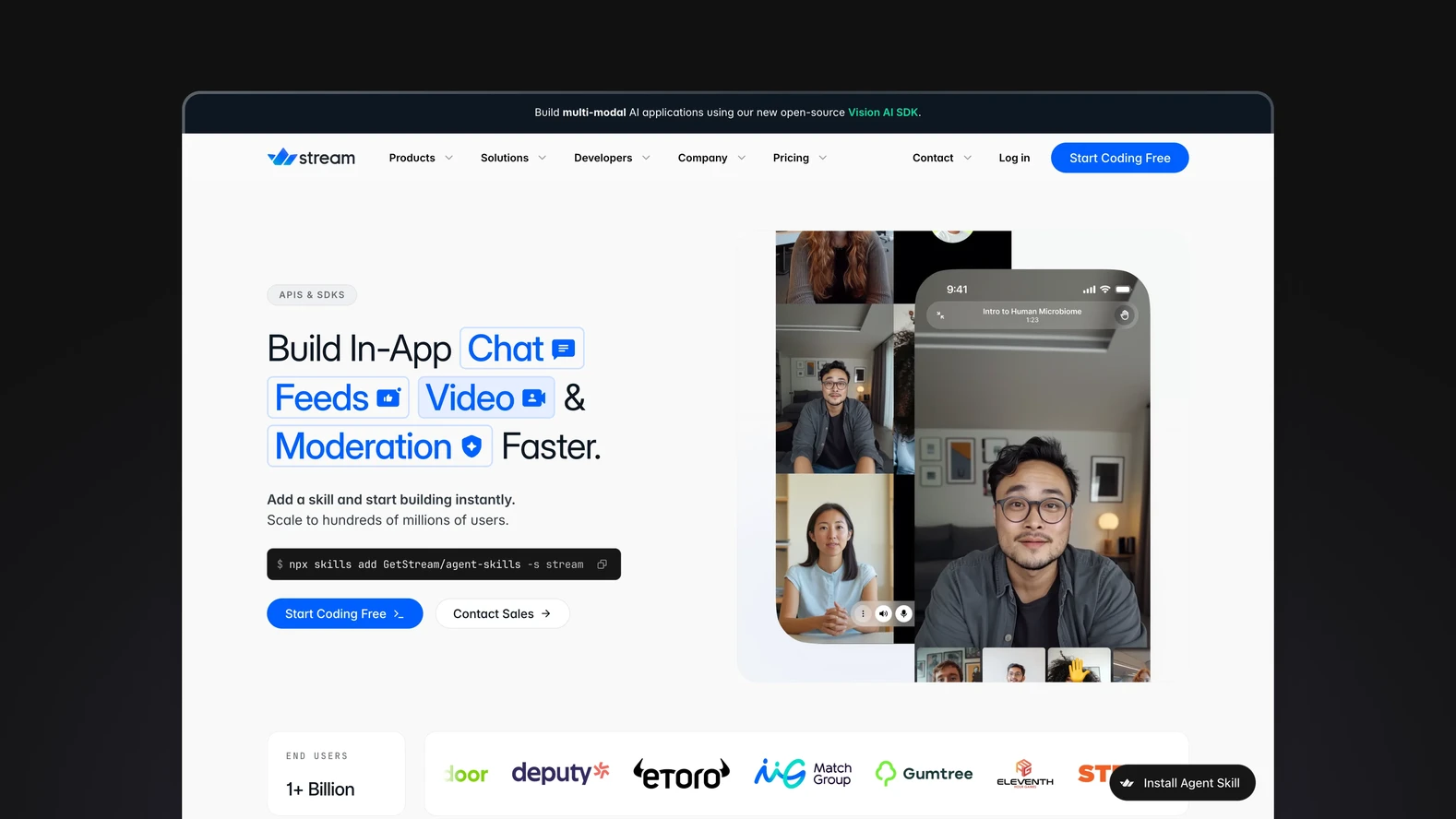
Stream provides Chat, Activity Feeds, and Video as separate SDK products, each with UI component libraries that support theming and customization. Components can be restyled to match your app's brand, and the underlying APIs are available for teams that want to build fully custom front-end experiences.
Key strengths:
- UI component libraries for Chat, Feeds, and Video that support theming and layout overrides, giving teams a branded starting point they can ship fast and customize over time
- Full APIs alongside every component, so teams can go fully custom on specific parts of the experience while using pre-built components everywhere else
- Broad platform coverage across major frameworks, keeping the white-label experience consistent across every surface users are on
- Thorough documentation with theming guides and working examples for each product, reducing the learning curve for teams building branded experiences
Considerations:
- Each white-label capability (Chat, Feeds, Video) is a separate SDK with separate integration. Teams building a multi-feature branded community experience integrate and manage each product independently.
- Stream provides the white-label building blocks. Unified branding across products, branded analytics dashboards, and monetization features are managed by your team on top of Stream's individual products.
Pricing: Per-product pricing. Free build tiers available. Enterprise is custom.
Best fit: Engineering teams that want white-label building blocks for specific community features and prefer the flexibility to mix pre-built components with fully custom front-end work.
Sendbird: Best for apps that need white-label messaging with enterprise branding control
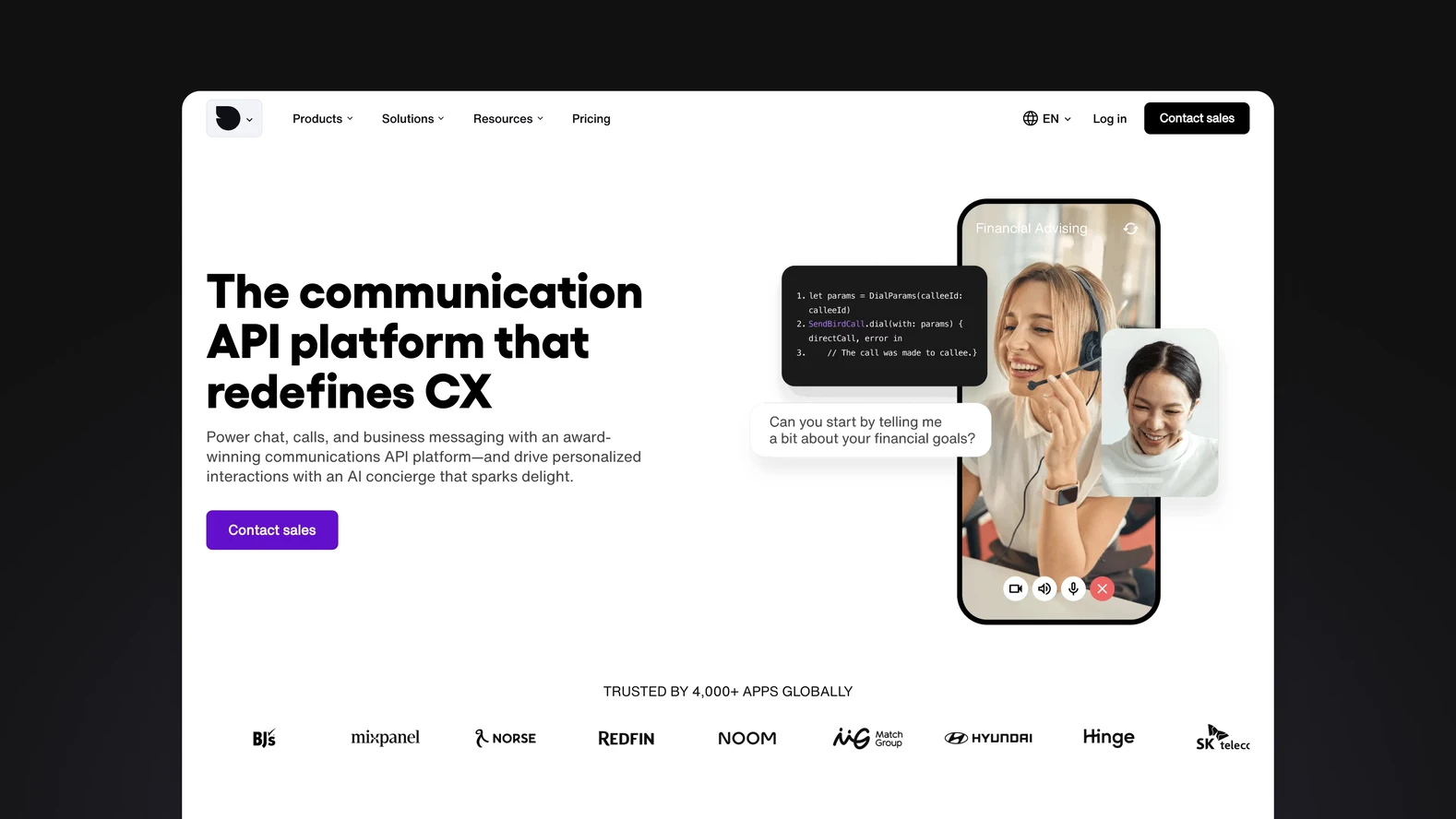
Sendbird provides Chat, Voice, Video, and Live Streaming SDKs with UIKit components for React, SwiftUI, and Jetpack Compose. Components support theming and customization to match your application's brand, and the platform operates entirely behind the scenes with no Sendbird branding visible to end users.
Key strengths:
- UIKit components for React, SwiftUI, and Jetpack Compose with theming support, so teams ship a branded messaging experience without building every UI element from scratch
- Chat, voice, video, and live streaming all operate behind the scenes with no third-party branding, keeping the entire communication layer invisible to end users
- SOC 2, HIPAA, ISO 27001, and GDPR compliance, making it viable for branded experiences in regulated industries
- Supergroup channels supporting up to 20,000 users, giving brands the infrastructure for large-scale community spaces under their own name
Considerations:
- Sendbird's white-label scope covers messaging, voice, video, and live streaming. Social feeds, stories, content discovery, and broader community features beyond conversation are outside the platform. Teams needing a branded experience across multiple social surfaces build those layers separately.
- UIKit components are available for React, SwiftUI, and Jetpack Compose. Teams building on other frameworks use the APIs to build custom branded UI, which gives full control but requires more front-end development.
Pricing: Tiered plans through Enterprise. Enterprise includes custom pricing and dedicated support.
Best fit: Teams that need white-label messaging and communication features with enterprise-grade compliance, where the branded experience centers on chat and real-time conversation.
CometChat: Best for apps that need white-label chat with visual builders for fast brand customization
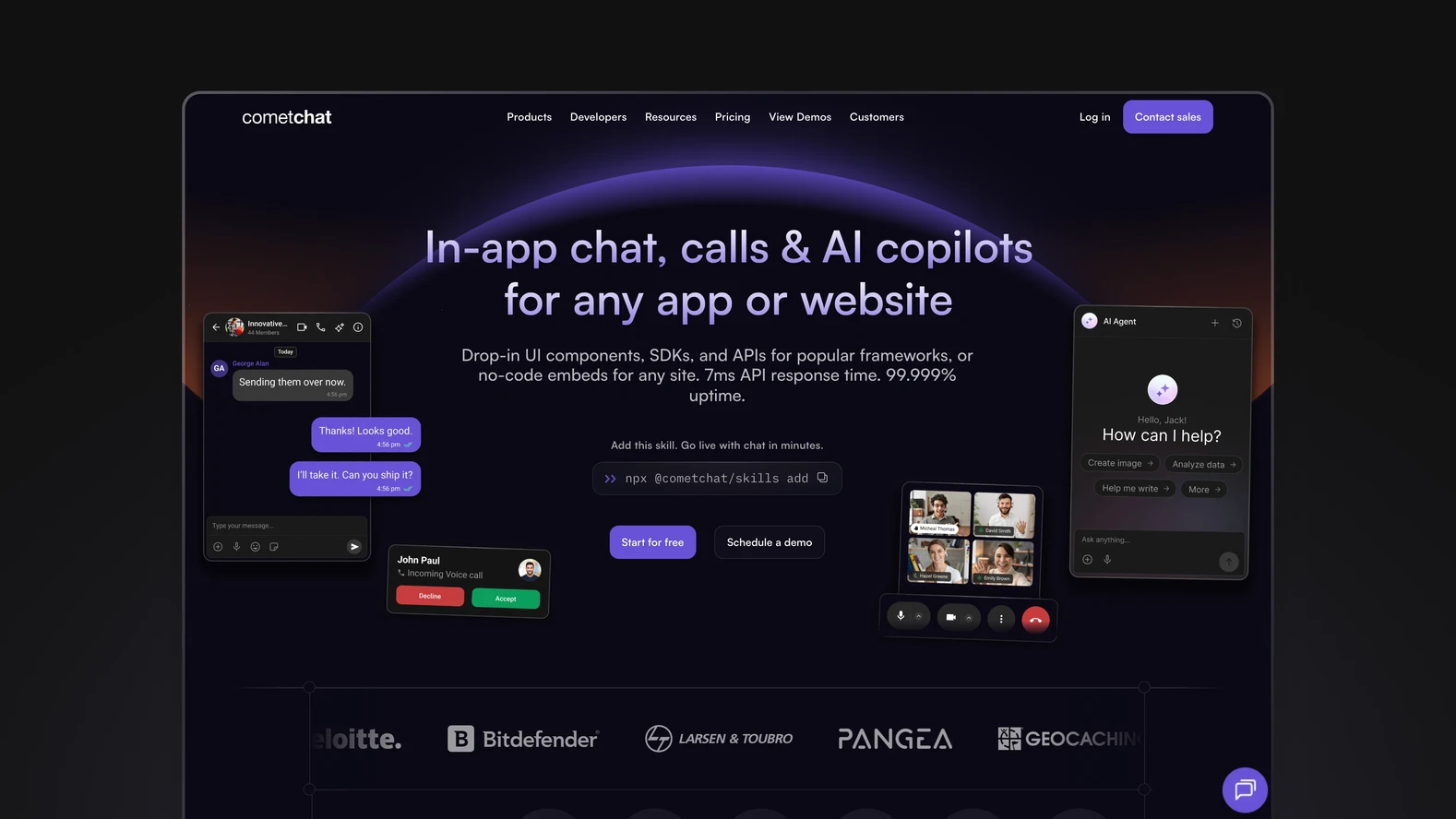
CometChat provides Chat and Voice/Video Calling SDKs with UIKits across React, React Native, Flutter, iOS, and Android. The platform includes a Widget Builder and UI Kit Builder that let teams configure and brand chat experiences visually, reducing the front-end work needed to ship a branded look.
Key strengths:
- Widget Builder and UI Kit Builder that let teams configure branded chat visually, cutting the front-end development time it typically takes to match your app's look
- UIKits across five platforms (React, React Native, Flutter, iOS, Android) with customization support, so the branded chat experience stays consistent across every surface
- Multi-tenant infrastructure that supports white-labeling across multiple brands or customer segments from one backend, ideal for platforms serving their own customers
- Compliance across ISO, HIPAA, SOC 2, GDPR, PIPEDA, and COPPA, covering a wide range of regulatory requirements for branded chat
Considerations:
- CometChat's white-label scope centers on chat and calling. Social feeds, stories, content sharing, and broader community features beyond conversation are outside the platform. Teams needing a full branded community experience build those capabilities separately.
- The Widget Builder and UI Kit Builder accelerate branded launches but may have constraints for teams with highly custom design requirements. For maximum control, the underlying APIs and UIKit components offer deeper customization.
Pricing: Free Build plan. Tiered MAU-based pricing. Enterprise includes custom pricing and zero overages.
Best fit: Teams that need white-label chat integrated fast, with visual builders that reduce the design and development effort needed to match their brand, particularly across multiple brands or tenants.
Agora: Best for apps that need white-label voice, video, and live streaming experiences

Agora provides Voice Calling, Video Calling, Live Streaming, Broadcast Streaming, Chat, and Signaling SDKs with native support across iOS, Android, Web, React Native, Flutter, and Unity. All capabilities operate as white-label infrastructure, with no Agora branding visible to end users. The platform includes AI extensions for audio and video quality optimization.
Key strengths:
- Voice, video, and live streaming SDKs that operate entirely behind the scenes, giving brands full ownership of the real-time experience without any third-party footprint
- AI extensions for noise suppression, speech-to-text, and adaptive video quality that improve the branded experience invisibly, so users get better sessions without knowing an external provider is involved
- Low-latency global infrastructure that keeps the branded real-time experience performing consistently regardless of where users are
- SDK coverage across iOS, Android, Web, React Native, Flutter, and Unity, supporting branded experiences in gaming and interactive apps alongside standard platforms
Considerations:
- Agora's white-label scope is real-time communication: voice, video, and live streaming. Social feeds, content creation, user profiles, and broader community features are outside the platform. Teams building a full branded community layer build those parts separately.
- Agora provides the white-label infrastructure and SDKs, but the UI is built by your team. There are no pre-built UI component libraries for the social experience, so achieving a branded look requires custom front-end development.
Pricing: Per-product, usage-based pricing. Free minutes included. Enterprise is custom.
Best fit: Teams building apps where the branded experience centers on live audio, video, or streaming, and where the white-label requirement is that users never know an external provider powers the real-time layer.
PubNub: Best for teams that want to build a fully custom branded community on real-time infrastructure
PubNub provides real-time infrastructure SDKs built on a publish/subscribe model, covering messaging, presence detection, serverless Functions, and file sharing. The platform operates entirely as infrastructure with no pre-built UI and no third-party branding, which means every pixel of the user experience is designed and owned by your team.
Key strengths:
- White-label by default: PubNub is infrastructure with no UI layer, so every element of the branded community experience is designed and controlled by your team
- Sub-100ms global latency and 99.999% uptime SLA that ensure the custom-built branded experience performs reliably at scale
- Illuminate and BizOps Workspace that add operational and analytics tooling on top of the infrastructure, reducing the management burden without exposing third-party branding
- Compliance across GDPR, HIPAA, SOC 2 Type 2, SOC 3, and ISO 27001 for branded experiences in regulated environments
Considerations:
- PubNub is white-label by nature because it's infrastructure, not a community platform. The white-label advantage comes with the requirement that your team builds every UI element, interaction pattern, and community feature from scratch. This gives total branding control but requires significant engineering investment.
- PubNub is most relevant when your white-label needs extend beyond community into IoT, gaming, live events, or operational data, where the same branded infrastructure serves multiple product surfaces.
Pricing: Free tier available. Enterprise plans are custom with dedicated support.
Best fit: Engineering teams that want total control over every element of the branded community experience, especially when the same real-time infrastructure powers multiple white-label product surfaces beyond community.
At-a-Glance Comparison
| Platform | Best for | White-label scope | UI customization approach | Pre-built components | Pricing model |
|---|---|---|---|---|---|
| social.plus | Full community experience running natively under your brand | Chat, feeds, stories, events, live streaming, moderation, analytics, monetization | Themeable UIKit + full APIs | Yes, across 5 platforms | Contact for pricing |
| Stream | White-label social building blocks with API flexibility | Chat, activity feeds, video (separate products) | Themeable components + full APIs | Yes, per product | Per-product pricing |
| Sendbird | White-label messaging | Chat, voice, video, live streaming | Themeable UIKit + APIs | React, SwiftUI, Jetpack Compose | Tiered, enterprise custom |
| CometChat | White-label chat with visual builders | Chat, voice/video calling | Widget Builder + UI Kit Builder + UIKits | Yes, across 5 platforms | MAU-based, enterprise custom |
| Agora | White-label voice/video/streaming | Voice, video, live streaming, chat | APIs only (custom UI required) | No | Usage-based, enterprise custom |
| PubNub | Fully custom branded community | Messaging, presence (community is custom-built) | APIs only (custom UI required) | No | Enterprise custom |
How to Choose the Right White-Label Community Platform
With six platforms covering different scopes and approaches to white-labeling, the decision comes down to five things.
How much of the community experience you want under your brand. If you need one white-labeled capability like chat or live video, a focused platform covers that fast. If the branded experience should span feeds, stories, events, live streaming, and more, a full-stack platform means a unified brand experience from a single integration.
Whether you want pre-built components or full custom UI. Pre-built UIKit components with theming support get you to a branded launch faster. Building a fully custom UI on APIs gives you total control but requires more front-end development. Some platforms offer both, letting your team start with components and go custom where it matters.
How many platforms your users are on. The branded experience needs to feel native on iOS, Android, Web, and cross-platform frameworks. Check that the platform's white-label components and theming capabilities cover every platform you're shipping on.
How data ownership works. White-label means your brand owns the experience, and it should also mean your team owns the data. Evaluate whether the platform provides full API access to user and content data, data export capabilities, and whether engagement data can flow into your own analytics infrastructure.
How moderation and governance work under your brand. When community features carry your name, every piece of content reflects on your product. Evaluate whether moderation tools, content filtering, and admin workflows operate within the branded experience and give your team direct control.
The best white-label community platform is the one that makes the community features feel like they were built by your team, while handling the infrastructure, scale, and complexity underneath.