A moderation rule that is too broad can do more damage than having no rule at all. Testing against live content shows you exactly who a rule would catch before it touches a single user, and the way you read those results decides whether the rule earns your users' trust or quietly erodes it.
The rules that cause the most harm are rarely the obviously wrong ones. They are the rules that work almost perfectly: they catch the spam they were written for, and they also catch a small, steady share of real users doing nothing wrong. Those users are often the most active people in your app, because activity is what makes someone look unusual to a rule. Nobody sees the problem on the moderation side. The first sign is usually a complaint, or a regular who quietly stops posting.
A rule definition cannot tell you any of this. "Comment contains a link" reads as a sensible rule on paper. Only real traffic reveals that a third of the links in your app come from long-time users sharing articles they like. That is what testing is for, and it is why a rule should never go from idea to Active in one step.
What a test run shows you that a rule definition cannot
When a rule is in Test, it runs against live content as it happens. Every time the rule would have fired, the trigger appears in the moderation history log, marked as Test mode, with no action applied: nothing is hidden, muted or deleted, and no user is notified. You get the full picture of how the rule would behave on your real traffic without anyone being affected, in the same place your team already reviews what moderation has done.
That log answers three questions a rule definition never can:
- Who would this catch? Not in theory, but which actual users and which actual content.
- How often? A rule that fires twice a day and one that fires two hundred times a day need very different levels of confidence.
- Would I stand behind each of these? This is the question that matters most. If the rule had acted on every entry in the log, would your team defend each decision to the user on the receiving end?
Test through your busiest moments, not your quietest
A test only tells you about the traffic it saw. A rule tested on a slow weekday afternoon has not met your peak, and peak moments are exactly where rules misfire: a product drop, a big match, a viral post, a campaign launch. Activity spikes, people post faster, and behavior that looks suspicious on a quiet day becomes normal for a few hours.
There is no fixed number of days that makes a test complete. A better rule of thumb is to keep a rule in Test until it has seen at least one full cycle of your usual activity, including the moments when your app is busiest. For rules tied to specific events, such as live chat during broadcasts, test through at least one real event before switching on.
Read the log in both directions
Most teams read a rule's Test mode entries in the moderation history looking for one thing: did the rule catch the spam? That is half the reading. The other half is checking for what should not be there.
- False positives are real users the rule would have caught. These are the entries that turn into complaints.
- Misses are content you can see is a problem but which the rule did not log. These tell you the rule is too narrow, or that the behavior needs a second rule.
Which one to fix first depends on how severe the rule's response is. For a rule that hides content and sends it to a moderator, a few false positives are tolerable, because a person reviews each one and the content stays recoverable. For a rule that deletes or bans, the tolerance for false positives should be close to zero. The harder the response, the cleaner the log needs to be before the rule goes live.
Fix noisy rules with conditions before thresholds
When a log is full of false positives, the instinct is to make the rule less sensitive: raise the posting-speed number, raise the report count, raise the AI harm sensitivity. Sometimes that is right. More often, it trades one problem for another, because a higher threshold makes the rule less likely to fire on everything, including the spam it was built for.
Adding a condition is usually the better fix, because it describes the behavior more precisely instead of just turning the volume down. If a link rule is catching long-time users sharing articles, the issue is not that links are too common. The issue is that the rule cannot tell a trusted user from a new account. Adding "account is less than 14 days old" with AND removes the false positives without making the rule any weaker against the accounts it was written for. NOT does the same job for groups who should never be caught at all, such as staff, hosts and moderators.
After any change, run the test again. A fix that looks right in the builder still has to prove itself on live content.
Let the response grow with your confidence
A clean test log is a strong signal, but it is not the same as a track record. A practical pattern is to launch a new rule with a lighter response than you ultimately want, then step it up once the rule has proven itself while Active:
- Start with a flag, or hide and send to a moderator, so every decision still passes through a person while the rule is new.
- Move to mute or delete once the moderator queue shows the rule is consistently right.
- Reserve bans for rules whose logs and history leave no room for doubt.
Logging a reason with every action makes this much easier. When it is time to decide whether a rule has earned a harder response, the reasons in the queue are your evidence.
Test changes, not just new rules
Rules drift out of date. Your users change, new markets bring new behavior, and spammers adapt to whatever is stopping them. Editing an Active rule directly means testing the change on your users in real time, which is exactly what Test exists to avoid.
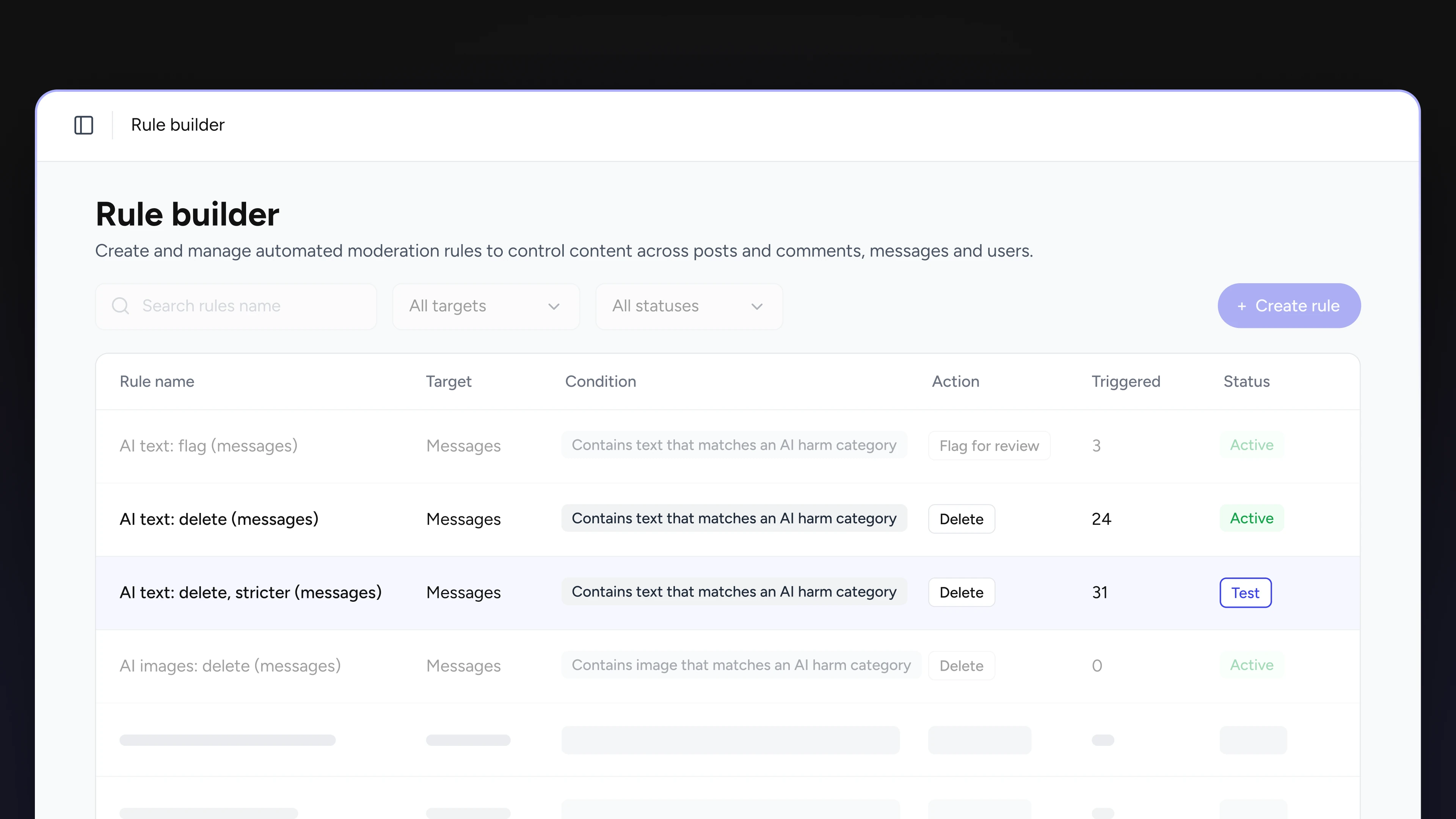
The safer pattern is to build the stricter or broader version as a separate rule in Test, alongside the Active one. Let both run through a busy period, then compare what the Active rule did with what the Test version logged in the moderation history. If the new version catches what the old one missed without adding false positives, switch it to Active and set the old one to Inactive. If not, you have lost nothing. Inactive is also the right state for rules that only matter some of the time, such as seasonal campaigns or a tournament, so they can be switched back on without being rebuilt or retested from scratch.
Where to start
Pick the rule your team trusts least, or the one that generates the most "why was my post hidden?" messages. Build a more specific version of it, put that version in Test next to the original, and let both run through your next busy period. Read the log in both directions, fix with conditions before thresholds, and switch over only when you would stand behind every entry.
The Moderation Rule Builder, including Test mode, is available in the social.plus Console on every network. Learn more about testing rules, or contact our team for questions or help setting up your first rules.