
1. Planning
Plant the right seeds
Planning out the foundation of your community is a necessary step to complete before you introduce a community to your platform. Unfortunately, many communities launch without a clear goal, leading them to fail from the start. We're here to help you set up your community for success.
Key points
Laying the foundation of your community comes down to the WHY, WHO, WHAT, and HOW.
The WHY
The most important factor in planning your community is having a clear WHY. A community without a purpose and without benefits for all its members will inevitably encounter potential points of failure.
While the community you're building is primarily focused on your users, it's important to remember that the business itself is also a member of the community. It's about more than just creating a space for the community. The active contribution from the business will keep the community engaged and growing. And just like any other community member, the business is only effective when the community provides value to it as well.
In a successful community implementation, activity in the community directly overlaps with the business goals to generate value.
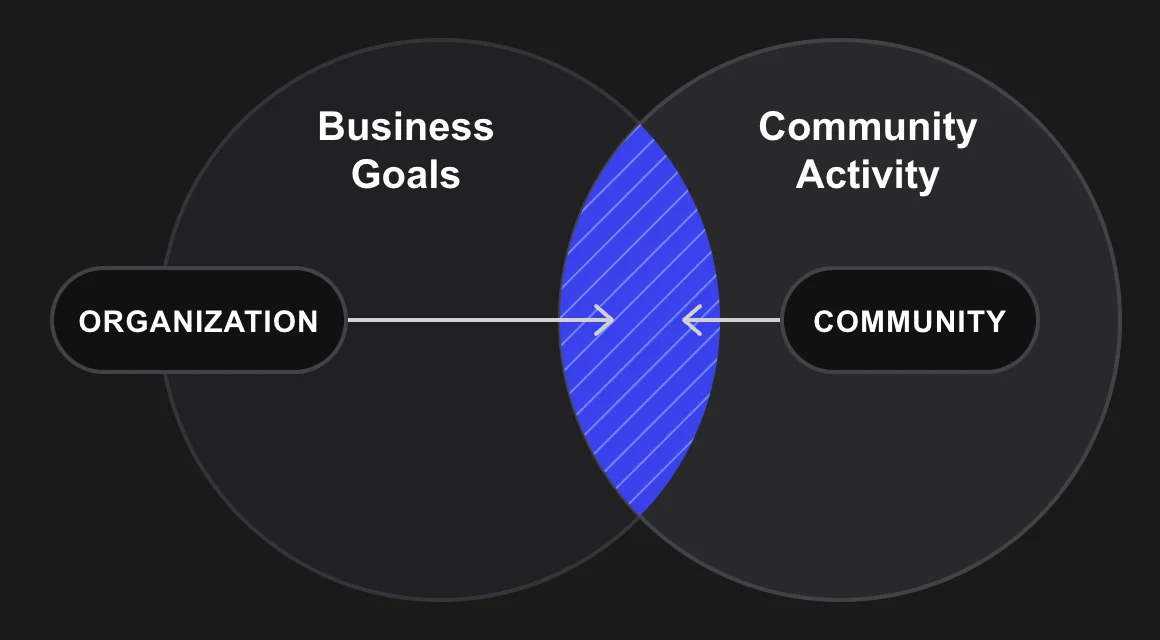
By understanding the areas where community can overlap and drive an impact on your business, you can focus in on the key takeaways you want from your community. The SPACES Model shown below, created by David Spinks (Founder of CMX) provides a few key areas to consider where communities can benefit your business:
The SPACES Model
Support
Improving customer satisfaction by having members provide supports
Metrics to Track
- Decrease number of support requests
- Engagement
Product
Gaining new insights for ideas on features or product development
Metrics to Track
- Users generated content
- Customer satisfaction
Acquisition
Gaining new users via top members in the community
Metrics to Track
- New users
- MAU
- Engagement
Contribution
Collaborating across the platform
Metrics to Track
- New users
- MAU
- Users generated content
Engagement
Improving users loyalty and retention rate
Metrics to Track
- Engagement
- Users generated content
- New users
Success
Empowering average users to become more active by connecting them
Metrics to Track
- MAU
- New users
- Retention rate
- Customer satisfaction
The WHO
Communities are the foundation of humanity, and humans are at the core of communities. Understanding WHO you’re empowering through your communities enables you to plan with their needs in mind, significantly enhancing the value created for them.
Narrow down your focus by evaluating the following:
- What are your primary user demographics? Demographics: age, occupation, location, segment, etc.
- Who are the users you want to bring together in your community?
- Who are the people you aren’t targeting?
See more (4)See less
- What level of technology are these users comfortable with?
- What are the main day to day interactions they take part in on your platform?
- What do they appreciate most about your platform?
- How can the platform provide them with a better experience?
To answer the above, it’s necessary to have an in-depth understanding of your user base. TIP: Conducting user interviews can help in highlighting some key points to consider.
The WHAT
Once you’ve identified your target user base, it becomes easier to determine WHAT you should provide to your users. Understanding what will bring your community members together and what they need further shapes the core identity and values of your community.
It’s important to have a clear understanding of your target user base:
- What are their values?
- What are the problems they face?
- What are their goals or motivations?
See more (2)See less
- What problems does your community solve for members?
- What opportunities does your community create for members?
The HOW
By carefully assessing the current user journeys on your platform, you can seamlessly incorporate community capabilities into their existing habits, making it easier to encourage adoption in the future. This evaluation also assists in understanding HOW your users will interact on your platform.
When evaluating your user journey it’s important to consider:
- Which parts of the platform currently get the most user interaction?
- Which touch points in these parts of the platform can be strengthened with community capabilities?
Creating a plan for HOW users will interact with each other requires thinking out:
- How can you enable more cross-user interactions in the parts of the platform where users already engage with the business?
- How will users interact with each other? What activities will you enable them to do?
- How are you going to give users a chance to contribute regularly to the community you are building?
See more (5)See less
- How can you build these interactions to be omnichannel, where possible?
- How and where will you communicate your community purpose to your members?
- How will you communicate the ground rules of your platform and moderate content accordingly?
- How does your place of gathering make your members feel safe?
- How does your place of gathering inspire members?
These questions are designed to help you brainstorm now to save you headaches in the future by eliminating problems before they happen and helping you define the right roadmap to success.
Defining your community mission
Everything we have done till now is to define your community mission statement.
Clear and well-defined answers for the WHO, WHAT, HOW, and WHY allow for the formation of a clear mission statement for one’s community. It should be easy to articulate the reason for your community’s being.
We are building a community for [who] with a common value of [what], allowing members to interact by [how], ultimately generating a value for us by [why].

Fill in the fields above and download the image, which you can use in presentations and share on social media.
Final thoughts
- Having a clear understanding and goal for your community is vital to its long-term success.
- Diving deep into your WHY, WHAT, WHO, and HOW will help you understand your community's mission and the value you provide.