
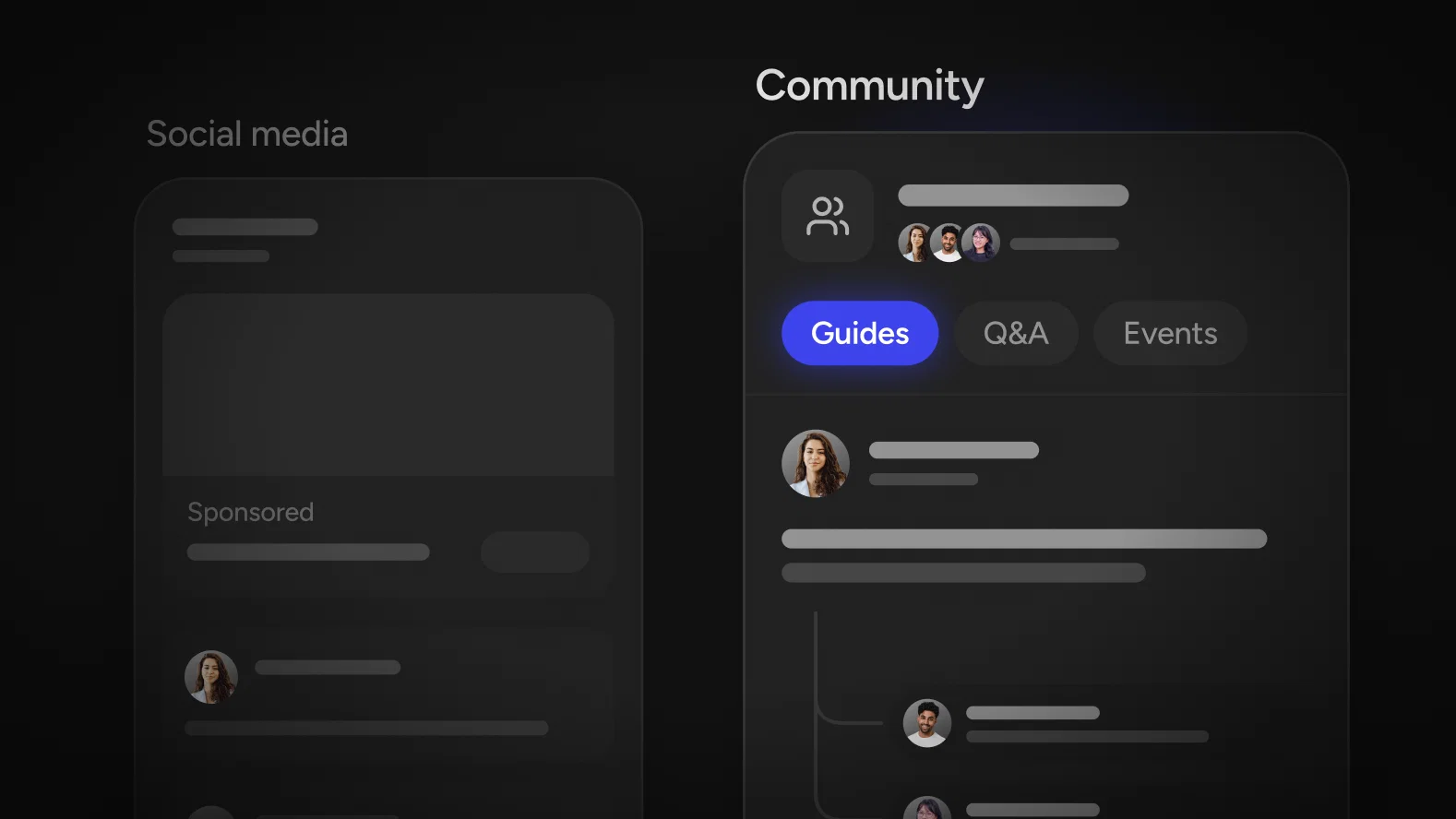
Online communities vs. social networks is more than a naming question: the terms are often used interchangeably, but they solve different problems. A social network connects a person's individual circle of friends, family, and professional contacts inside one company-owned platform, with content ranked by an algorithm optimized for engagement and ad revenue. An online community connects people around a shared interest, product, or identity inside a space that a brand, app, or dedicated platform can control directly, with content organized by topic rather than by feed.
The two are easy to confuse because both involve groups of people interacting online. The difference that matters for a brand or app is who owns the space, how content is structured, and how the relationship with users is monetized.
What Is an Online Community?
An online community is a purpose-built space where users gather around a shared interest, product, or identity, rather than around a personal social graph. Ownership and moderation sit with the brand, app, or platform hosting it, not with a third-party algorithm deciding what content users see.
Online communities can take different forms. Some live on dedicated third-party platforms like Reddit or Discord, organized as subreddits or servers around a topic. Others are built directly into a brand's own app as an in-app community, where discussions, groups, and chat sit alongside the product itself rather than on a separate site. For a deeper technical breakdown of what qualifies as a community platform, see the social.plus glossary on community platforms.
What Is a Social Network?
A social network is a platform built to represent and extend a person's real-world connections, such as friends, family, coworkers, or professional contacts. Facebook, Instagram, LinkedIn, and X are classic examples, and each generates revenue primarily through advertising rather than through the communities they host.
Content on a social network flows through an algorithm-ranked feed rather than a topic-based structure. That feed is optimized for time spent on the platform, which means posts are typically most visible shortly after they're published and lose visibility quickly afterward. The platform, not the brand or the individual user, controls distribution, data, and the rules of engagement.
Why People Join Each One
People join social networks and online communities for different reasons, and that difference shapes how each platform behaves. A social network grows because people want to stay connected to the relationships they already have, so its value comes from breadth: the more contacts, colleagues, and acquaintances on the platform, the more useful it becomes.
An online community grows for the opposite reason: depth over breadth. Users join because they want to go deeper on a specific interest, product, or identity than a general-purpose feed allows. That's why online communities tend to have a higher bar for participation and a stronger shared culture, while social networks optimize for the widest possible reach across the least specific content.
How We Compared Online Communities and Social Networks
We compared the two on the dimensions that change where a brand or app should invest, and left out traits that vary from one platform to the next, such as audience size or feature lists. Each row reflects how the platforms themselves are built and funded, backed by published reach data where it exists. Disclosure: social.plus publishes this blog and builds community and chat infrastructure, so treat its inclusion accordingly.
Online Community vs. Social Network: Key Differences
Online communities and social networks differ across five practical dimensions that matter most to a brand deciding where to invest: purpose, ownership, content lifespan, monetization, and typical examples.
| Dimension | Online community | Social network |
|---|---|---|
| Purpose | Brings users together around a shared interest, product, or identity | Represents and extends a person's real-world social graph |
| Ownership | Can be owned and controlled by the hosting brand, app, or platform | Owned and controlled by the social network company |
| Content lifespan | Organized by topic or channel; content stays discoverable and referenceable over time | Organized by feed; content is time-decayed and quickly buried |
| Monetization | Funded as part of a product or retention strategy, or through direct subscriptions | Funded primarily through advertising tied to time spent on the platform |
| Example | Reddit, Discord, or a brand's in-app community | Facebook, Instagram, LinkedIn, X |
One nuance the table simplifies: not every online community is brand-owned. A subreddit or Discord server is still hosted on someone else's infrastructure, even though it's organized around a topic rather than a personal network. True ownership requires building the community into a product the brand controls, typically through APIs, SDKs, and UIKit components rather than a hosted third-party space.
Why the Distinction Matters for Brands and Apps
The distinction matters because a brand's relationship with users looks different depending on where the conversation happens. On a social network, a brand rents attention from a platform it doesn't control. In an owned online community, a brand builds infrastructure it does control.
That difference has gotten more consequential as organic reach on major social networks has declined. Industry reporting places Facebook's average organic reach at roughly 16% in 2012, falling into the low single digits by 2025 as platforms increasingly prioritize paid distribution (Hootsuite, 2025). For a brand or app relying on a social network to reach its own users, that decline means paying for visibility into an audience it doesn't own and can't fully see the data on.
An owned in-app community changes that equation. The brand or app controls the product experience, has direct access to user and engagement data, and isn't subject to a third party's algorithm or policy changes. Moderation rules, content structure, and monetization models can be designed around the brand's own use case instead of a social network's advertising business.
That control doesn't produce engagement or retention on its own. Building a community that users actually return to still requires deliberate product design, active moderation, and ongoing investment, regardless of where it's hosted. What ownership changes is who is accountable for that outcome and who holds the data and infrastructure needed to act on it.
Where In-App Communities Fit In
An in-app community is a specific type of online community built directly inside a brand's own app, rather than hosted on a separate platform or third-party site. This is the layer social.plus operates in: infrastructure that gives brands and apps the APIs, SDKs, and UIKit to build chat, feeds, groups, and moderation natively into their product.
Because the community lives inside the app itself, users don't have to leave the product to participate, and the brand isn't dependent on a social network's feed algorithm to reach them. That typically covers a few functional layers: chat and feeds for the conversations themselves, moderation tools to keep discussion on-topic and safe, and analytics to understand how the community is actually being used.
Teams evaluating this shift are usually comparing several approaches at once, from social-network-native groups to dedicated third-party community platforms to fully in-app infrastructure. A comparison of options is covered in social.plus's guide to community infrastructure platforms, and brands weighing social-network-hosted groups against owned alternatives can also see social.plus's breakdown of Discord and Facebook Groups alternatives.
Frequently Asked Questions
What is the difference between an online community and a social network?
An online community is a space organized around a shared interest, product, or identity, where content is grouped by topic and typically stays accessible over time. A social network is a platform organized around a person's individual connections, where content moves through an algorithm-ranked feed and is monetized primarily through advertising.
Is Facebook a community or a social network?
Facebook is a social network. It was built to represent and extend a person's real-world connections, and it is owned, operated, and monetized by Meta primarily through advertising. Facebook Groups can host community-style interactions inside that network, but the underlying platform, algorithm, and user data remain under Meta's control rather than the group's.
Why are brands moving from social networks to owned communities?
Organic reach on major social networks has declined sharply over the past decade as platforms prioritize paid distribution, making it harder for a brand to reach its own users without paying for every impression (Hootsuite, 2025). Moving conversations into an owned in-app community gives a brand direct access to user data and product-level control over the experience, though building an engaged community still depends on ongoing product and moderation work rather than happening automatically.
Can a social network host an online community?
Yes. Features like Facebook Groups, LinkedIn Groups, and subreddits let communities form inside a social network's infrastructure. The host platform still owns the data, algorithm, and rules governing how that community operates, which is why brands that want direct control over design, data, and moderation typically pair this presence with an owned, in-app community rather than relying on it alone.
Does an online community replace social media marketing?
No. Social networks remain useful for discovery, brand awareness, and reaching people who haven't engaged with a brand yet, since that's what their scale and reach are built for. An online community serves a different purpose further down the funnel: deepening engagement, supporting existing users, and building relationships a brand can access directly, so the two typically work alongside each other rather than as substitutes.
Choosing the Right Space for Your Users
The choice between a social network presence and an owned online community isn't binary. Most brands use social networks for discovery and reach, while building an owned in-app community for the retention, support, and deeper engagement they can shape directly. For a broader look at community-related terms and concepts, the social.plus glossary is a useful reference point.
If you're evaluating infrastructure to build an in-app community natively into your product, explore how social.plus's APIs, SDKs, and UIKit support chat, feeds, and moderation, or book a demo to talk through your specific use case.