App monetization is the set of methods an app uses to convert user activity into revenue, including subscriptions, in-app purchases, advertising, and commerce.
What is App Monetization?
App monetization decisions typically start with matching a model to usage patterns: apps with frequent, ongoing use tend toward in-app subscriptions, while apps built around discrete moments of value often lean on in-app purchases or advertising. Many apps combine more than one model rather than committing to a single revenue source, for example a free tier supported by ads alongside an optional subscription that removes them. Teams commonly scope monetization work around a small number of per-user metrics, chiefly ARPU and LTV, so that changes to pricing, ad load, or purchase flows can be compared on the same basis. One common caveat is that monetization changes interact with retention: raising ad load or price too aggressively can lift short-term revenue while pushing down the long-term usage that revenue depends on.
Why App Monetization Matters
In-app monetization determines whether an app can fund its own growth. Acquisition spend, infrastructure, and product development all have to be covered by revenue per user, so the monetization model sets the ceiling on how much a team can afford to pay for a new user.
For product and finance teams, the practical benefit of a clear monetization framework is better decisions about where to invest. Knowing which user segments generate revenue, and which behaviors precede a purchase or subscription, helps the team decide which features to build and which acquisition channels to scale.
How to Calculate App Monetization
App monetization is measured through a small set of per-user metrics that connect usage to revenue. The models differ in where the revenue comes from, but the metrics apply to all of them.
| Model | Revenue source | Key metric | Depends most on |
|---|---|---|---|
| Subscription | Recurring fee for access | Conversion to paid, churn rate | Retention and ongoing value |
| In-app purchase | One-time purchases of items or upgrades | Purchase rate, average order value | Session frequency and depth |
| Advertising | Payments from advertisers for impressions or clicks | eCPM, ad impressions per user | Time in app and session count |
| Commerce | Sales of physical or digital goods | Conversion rate, basket size | Trust and discovery inside the app |
| Hybrid | Combination of the above | ARPU across segments | Segmenting users by willingness to pay |
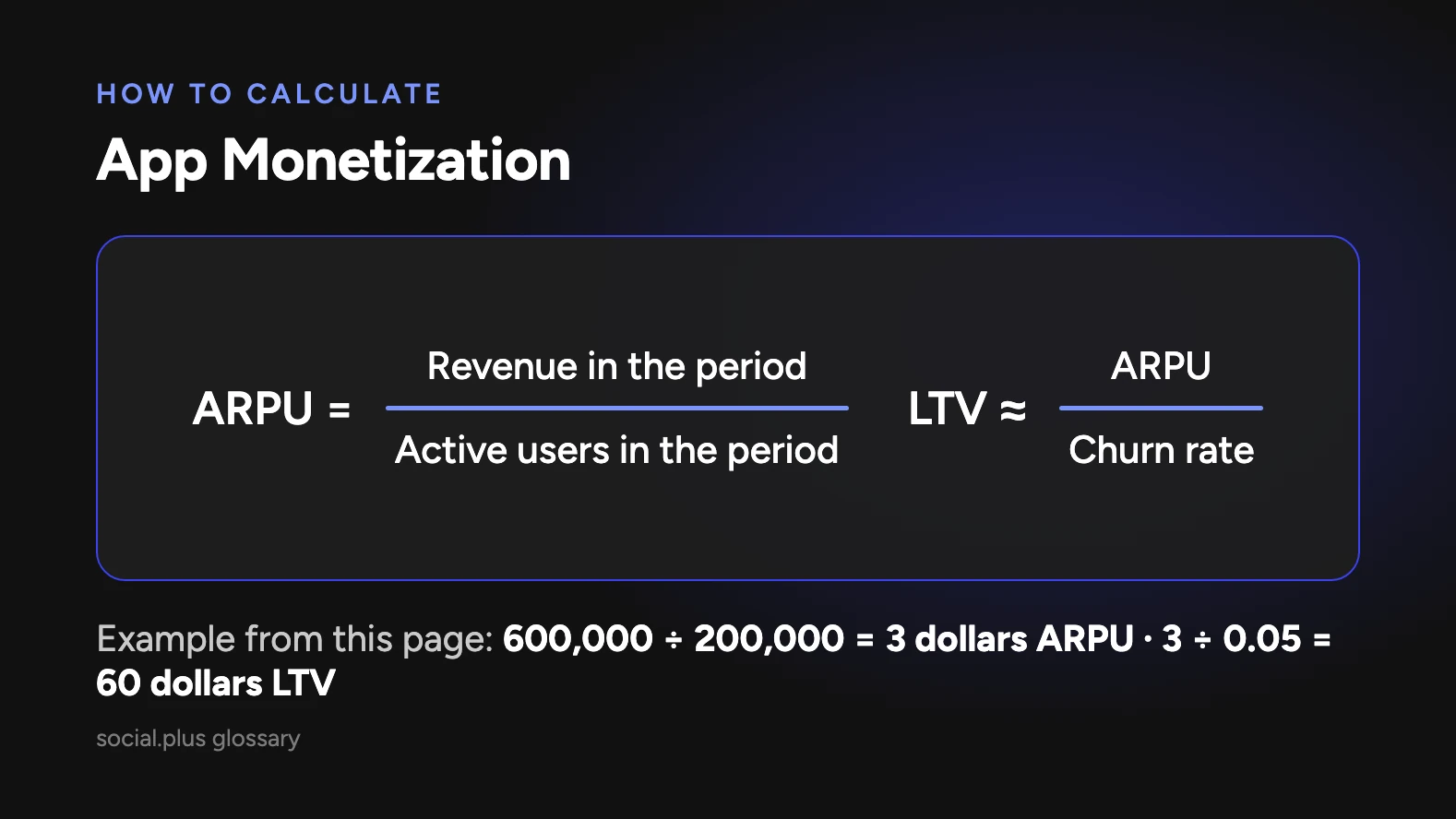
The two metrics that summarize any model are average revenue per user (ARPU) and lifetime value (LTV). ARPU is total revenue in a period divided by active users in that period. LTV estimates the total revenue one user generates before churning, commonly approximated as ARPU divided by the churn rate for the same period.
A worked example: a subscription app has 200,000 monthly active users and earns 600,000 dollars in a month. Monthly ARPU is 600,000 divided by 200,000, or 3 dollars. If the monthly churn rate is 5 percent, the estimated LTV is 3 divided by 0.05, or 60 dollars. If the team pays 25 dollars to acquire a user, the LTV to acquisition cost ratio is 2.4. Reducing churn to 4 percent raises LTV to 75 dollars without changing price or acquisition spend, which is why retention work is a monetization strategy.
App Monetization and social.plus
Engagement is the input that every app monetization model depends on, and social.plus provides the engagement infrastructure that increases it. Feeds, groups, chat, live streaming, and stories give users reasons to return and stay longer, which extends the period over which an app can earn from a subscription, sell a purchase, or serve an ad. Brands using social.plus have reported engagement rates of 20 to 50 percent and retention lifts of 10 to 35 percent. In the example above, a retention lift of that size is the difference between a 60 dollar and a 75 dollar LTV. Betgames, which serves 200 million users, and Ulta Beauty are among the brands building on this infrastructure.
Key Takeaways
- App monetization covers subscriptions, in-app purchases, advertising, and commerce, and most apps combine more than one.
- ARPU and LTV connect usage to revenue and apply to every model.
- Retention is a monetization lever: lowering churn raises LTV without changing price or acquisition cost.
- Engagement features that bring users back extend the window in which an app can earn from each user.