
Users Who Create Content Return 4× More Often – Why User-Generated Content Boosts Retention
Users who actively post content or comments are four times more likely to come back the next week compared to those who don’t.
In other words, someone who contributes to your app’s community has a vastly higher chance of returning than a passive user. This difference validates the power of user-generated content (UGC) and community features – when users contribute, they become significantly more invested and loyal. For product managers and community builders, the message is clear: encouraging users to create content isn’t just a nice engagement boost, it can quadruple their likelihood of sticking around.
Why does this 4× retention lift matter? In an era where acquiring new users is expensive and attention spans are short, loyalty is gold. A user who returns week after week drives higher lifetime value and can even become an advocate for your product. The fact that content creators return so much more often means UGC isn’t just fluff – it’s a strategic lever for growth and retention. Let’s break down what’s behind this phenomenon and how you can leverage it.
Active Participation Fuels Retention
The classic “90-9-1 rule” for online communities illustrates that the vast majority of users lurk while only a tiny fraction actively contribute. In a typical community, ~90% of users consume content without contributing, 9% contribute occasionally, and 1% create the most content. This imbalance means a small cohort of users generates most of the engagement. The “4× return” stat highlights just how valuable that contributing minority is: they’re far more engaged than the average user and they keep coming back. When a lurker turns into a contributor, they effectively join that top percentile of engaged members.
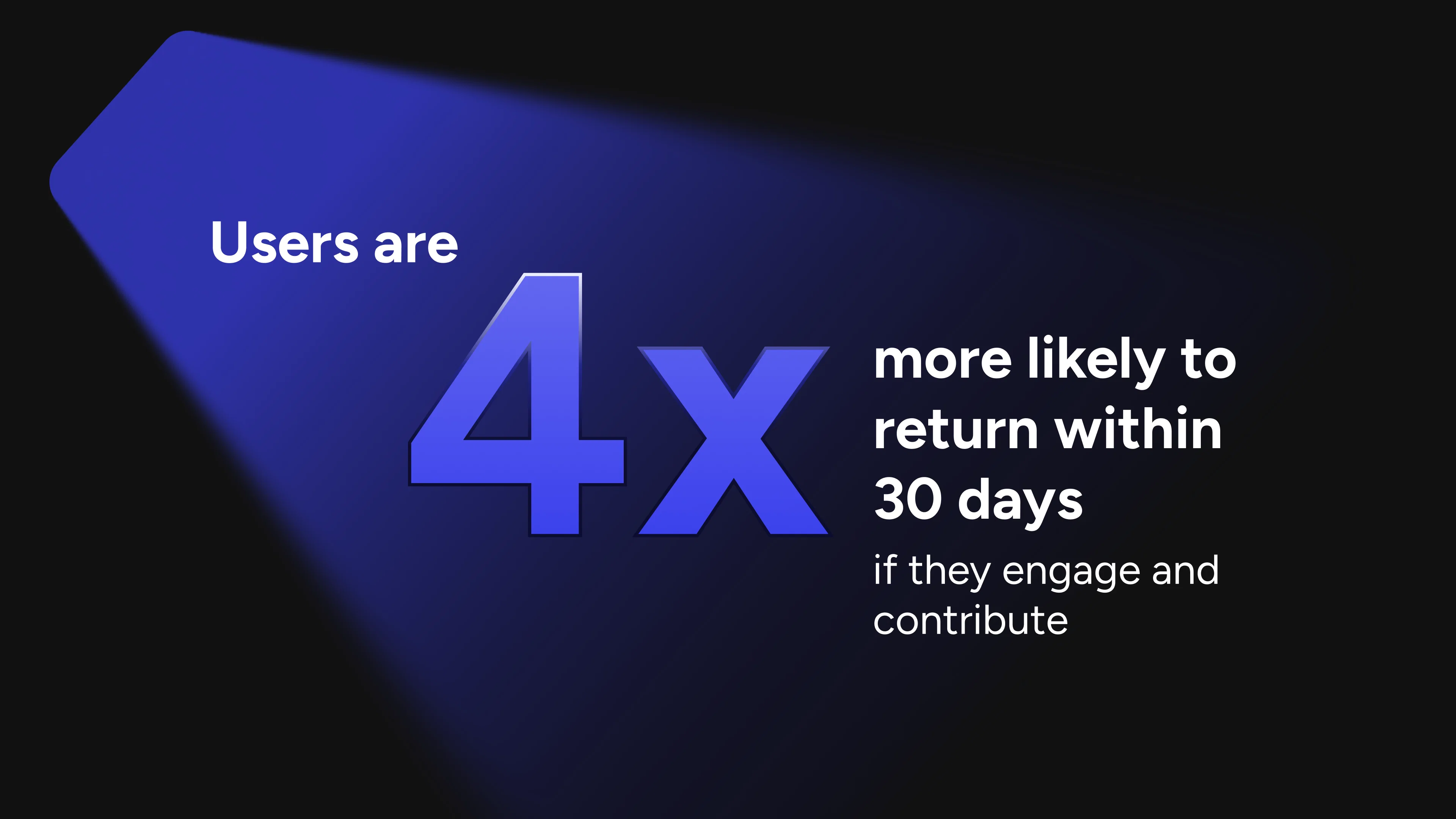
This pattern isn’t just seen in one app or isolated community; major platforms observe the same effect. For example, Spotify recently revealed that listeners who interact with a podcast show (by posting a comment, answering a poll, or participating in Q&A) are four times more likely to return to that show within 30 days. Not only did those interactive listeners come back more, they also listened to about twice as many hours of content per month as those who never engaged. In other words, engagement breeds loyalty: when users lean forward and participate, they derive more value and become repeat users. Likewise, in e-commerce, a study found that brands incorporating UGC on their websites saw a 20% increase in return visits. Across different industries, the story is the same: user contributions boost user retention.
The takeaway is clear: when users take action to contribute content, whether it’s a comment, a review, a post, or a photo, they transform from passive observers into invested community members. They’re no longer just scrolling; they’re part of the experience. This sense of participation creates a deeper bond with the product. It’s the difference between browsing a forum thread versus posting your own question. That heightened investment drives the 4× retention effect.
Why User Contributions Boost Loyalty
Why exactly do users who create content become so much more loyal? There are a few key reasons that product managers should understand:
Investment and Ownership
When a user contributes content, they’ve invested effort into the platform. It might be a thoughtful comment, an answer in a Q&A, a user review, or a creative post. That investment creates a sense of ownership. Psychologically, people value things more when they have put their own work into them. By creating something on your platform, users now feel a small sense of ownership and pride, which makes them naturally more inclined to return. They want to see “their” content and how it’s doing, and this personal stake ties them closer to your product.
Social Feedback Loops
User contributions trigger feedback from the community. A comment might receive replies, an answer might get upvotes, a post could earn likes or spark discussion. Each of those feedback moments (notifications, responses, reactions) is a hook that brings the user back. Active contributors often get rewarded with attention. Compare a user who never posts (and thus never hears from others) to one who posts and gets a dozen replies. The former has little pulling them back, while the latter now has multiple reasons to check in again (to read replies, continue the discussion, etc.). The act of contributing initiates a conversation rather than a one-way consumption, and that conversation can keep going indefinitely, driving habitual use.
Sense of Belonging and Community
Posting content helps a user move from feeling like just an “audience member” to feeling like a member of the community. When users see their own posts, comments, or content become part of the app’s fabric, it fosters belonging. They’re not just on an app; they’re among peers. This social belonging is a powerful motivator for sticking around. People return to places where they feel valued and heard. Community features like profiles, follower relationships, or contributor badges can further reinforce this. For example, if someone earns a “Top Contributor” badge after a few posts, they now have an identity and reputation in the community. In essence, contributing turns a solitary user experience into a shared social experience, and that makes users want to come back regularly.
Value Creation for the User
Often, the most engaged contributors are also the ones getting high value from the product. Consider a user who asks a question in a product forum and receives a great solution from others – that user just solved a problem by engaging, and they’ve learned that contributing yields tangible benefits. Or a user who writes a product review and gets feedback or appreciation might feel validated and useful to others. By contributing, users can unlock more value (answers, recognition, influence) than they would by quietly consuming. This positive reinforcement makes the platform more rewarding for them, which translates to higher loyalty.
In short, UGC flips the user’s mindset: from “this app is something I use” to “this is a community I’m part of.” That mindset shift is what fuels the surge in retention among contributors. It’s an insight that savvy product teams are now leveraging intentionally.
How Product Teams Can Encourage UGC
Knowing that user contributions drive engagement and retention, the next question for product managers is how to get more users to contribute. Here are some strategies to encourage UGC and turn more of your users into loyal creators:
Make contributing easy and intuitive
Reduce the friction for users to post or comment. Simple UI touches like a quick photo upload button or prompts like “Share your thoughts” can invite action. For new users, provide gentle guidance or default questions (e.g. a prompt to introduce themselves in a community) so the blank slate isn’t intimidating.
Onboard users into participation
Don’t wait weeks for a user to decide to post something, build contribution into the early user journey. For instance, a fitness app might ask a user to share their first workout or a cooking app might prompt a photo upload of their first recipe. By getting a user to make a small contribution early on, you break the ice. That first contribution is the biggest hurdle; once overcome, the user knows they can be a contributor here. Consider “achievement” nudges too (e.g. a message like “Thanks for your first comment!”) to positively reinforce that behavior.
Recognize and reward contributors
A little recognition goes a long way in motivating ongoing contributions. Highlight user-generated content prominently like feature the “post of the day” from a community member or send a thank-you note when a user’s review gets marked helpful. Implementing reputation points, badges, or contributor levels can tap into game-like incentives. When users see their contributions earn them status or appreciation, they’re more likely to contribute again. Even simple things like the original poster of a question being notified that their response was accepted or that they earned a new follower can reinforce the reward loop of contributing.
Foster interaction and feedback
Encourage the community to respond to content from new or less active users. Product teams can seed discussions or have community managers engage with every new post to ensure no contributor feels ignored. Also, features like @mentioning others, upvoting, or sharing content can amplify visibility for user posts.
Ensure a safe, inclusive community
Trust is the foundation of UGC. Invest in moderation tools and community guidelines so that contributing is a positive experience. Quickly remove spam or toxic replies, and encourage a supportive tone. When users feel safe and see that contributions are valued, they’ll be far more willing to share. A healthy community culture thus directly supports more UGC and retention.
Beyond the 4× Stat: Embracing a Community-First Strategy
This stat is more than just a curiosity; it’s a strategic insight. It highlights that your users aren’t just consumers, they can be partners in driving engagement. When you empower them to contribute, you’re effectively turning users into active stakeholders in your product’s community. That has a compounding effect on retention and growth. For teams sharing these insights through educational content, building topic clusters from one idea, such as UGC-driven retention, can lead to supporting topics around onboarding, feedback loops, community rewards, moderation, and long-term engagement.
Product managers often focus on features, funnels, and paid acquisition, but the success of many modern apps and platforms comes from building genuine communities. We’ve seen social networks, forums, and successful apps thrive by maximizing the ratio of contributors to lurkers. Even if your product isn’t a social network per se, adding community elements can pay off in loyalty; whether it’s a discussion section in a learning app or photo sharing in an e-commerce app. As the earlier example shows, even a traditionally non-social product can gain a stickier user base by leveraging UGC.
In the end, user-generated content is powerful because it fulfills fundamental human needs: to be heard, to connect, to express oneself. Those human factors translate directly into business KPIs like retention and lifetime value. So ask yourself: What are you doing to invite your users to contribute? Are you giving them reasons to take that step from passive use to active participation? Because if a single comment or post can make a user four times more likely to return, it’s time to double down on building features and communities that invite those contributions. In a world where engaged, loyal users are your greatest asset, creating more opportunities for UGC might just be the smartest product move you make. After all, a community that creates together, stays together.