45% of App Installs Are Uninstalled Within 30 Days
Nearly half of all new app installs are gone within just the first month. In other words, about 45% of people who download an app end up uninstalling it within 30 days.
That’s not just a vanity metric, it’s a glaring signal of a widespread “leaky bucket” problem in the app world. And here’s the kicker: a huge chunk of those uninstalls happen almost immediately. Roughly one in five users will use an app only once before dropping it altogether, and about half of all app uninstalls occur on the very first day after download. This means your window to capture a new user’s interest and prove your app’s value is incredibly small. If that first impression doesn’t hit the mark, your new user is likely gone as fast as they arrived.
Why it matters: A huge portion of acquired users churn almost immediately, underscoring the importance of a strong onboarding and early retention strategy. Growth teams can use this stat to highlight the leaky bucket problem – acquisition alone is not enough if nearly one in two users quits within weeks. User acquisition efforts that focus only on driving downloads, without addressing retention, are essentially pouring water into a bucket riddled with holes. The result? Marketing dollars and development effort leak out as lost users, and the app’s growth trajectory flatlines despite healthy download numbers.
Why So Many New Users Uninstall So Quickly
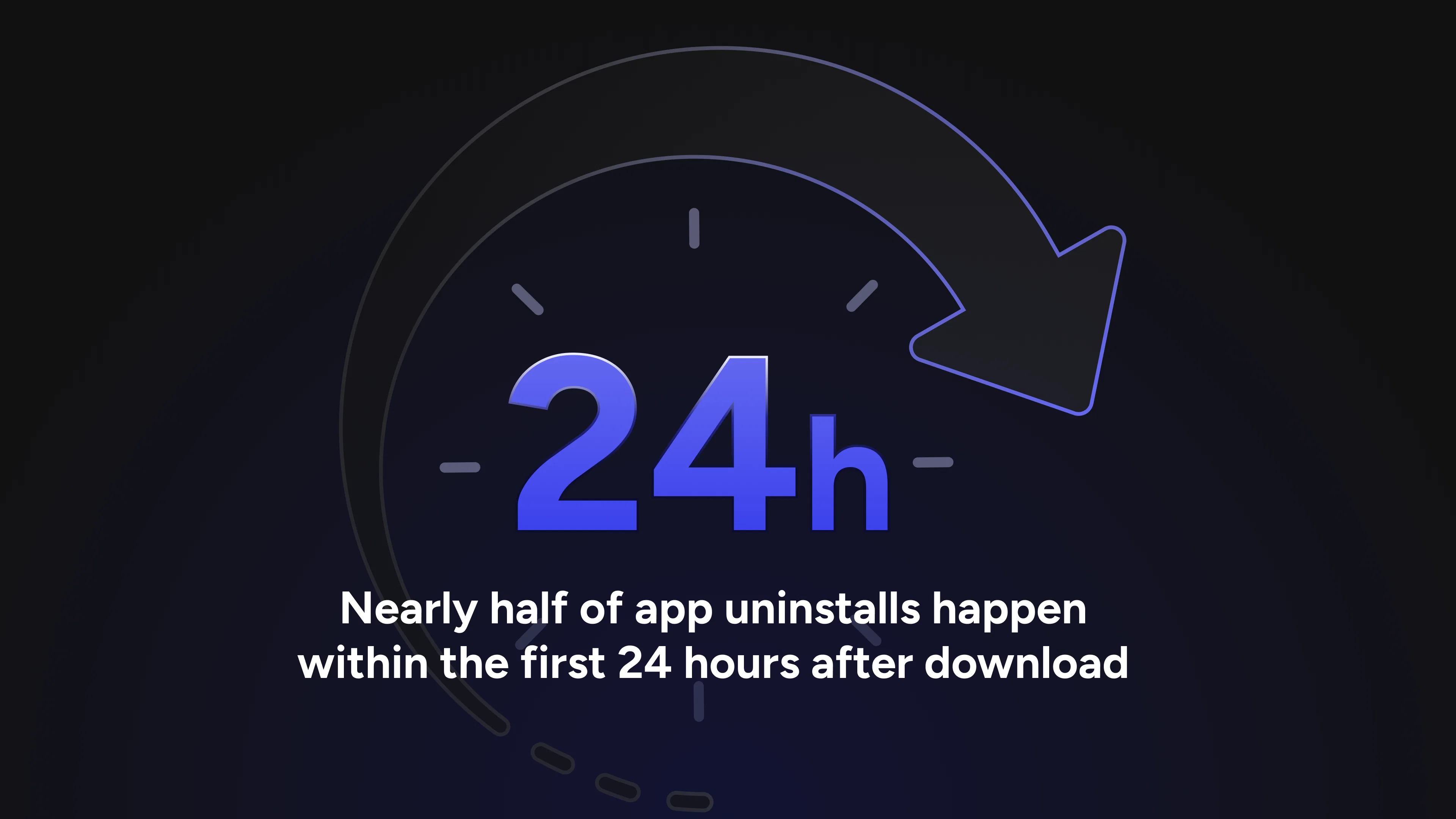
It might sound shocking that nearly half of users ditch an app within a month, but when you look at user behavior patterns, the statistic starts to make sense. User attention is incredibly fleeting in today’s crowded app marketplace. With millions of apps at their fingertips, users have zero patience for products that don’t immediately meet their needs or expectations. In fact, most uninstalls happen on Day 1. If an app fails to deliver clear value or a smooth experience on that first day, many users won’t hesitate to delete it. One industry report noted that approximately 49% of total app uninstalls occur within 24 hours of install. Users quickly try apps and just as quickly decide if they’re worth keeping.
Why are users so ruthless in pruning their apps? A big part of it is expectation vs. reality. Often, users install an app on a whim or via a flashy ad, but if the real experience doesn’t match what was promised, they feel let down and uninstall. App marketers can sometimes over-hype features in ads, leading to misaligned expectations that result in quick abandonment. Similarly, many installs are impulsive - so users download, poke around once, and then lose interest if nothing instantly hooks them.
Another factor is that users expect value fast. They won’t stick around waiting for an app to show its usefulness. If onboarding is too long or the core feature isn’t evident right away, users simply bail out. Every extra hurdle increases the odds of an uninstall in those early moments. Research shows that a cumbersome registration or sign-in process causes about 15.6% of users to abandon an app before they even really start using it. That means you can lose one out of six users purely due to a clunky sign-up flow. Users have come to expect that an app will prove its value within minutes, not hours, so any delay or friction in showing them “why this app is worth it” can be fatal to retention.
App quality issues are another major contributor to early churn. Users today have little tolerance for bugs, crashes, or slow performance. If the app is glitchy or sluggish out of the gate, you can bet the uninstall rate will skyrocket. In fact, over half of users (around 53%) say they will abandon or uninstall an app that has slow load times or poor performance. More than one in two users won’t give your app a second chance if it doesn’t run smoothly. Similarly, apps that drain battery or hog device resources often get axed quickly. Essentially, any sign of instability or inefficiency in the first use can break the user’s trust in the app.
Then there’s the issue of intrusiveness and annoyance. Nothing drives a new user away faster than feeling spammed or annoyed by the app. For instance, aggressive monetization or communication can backfire badly. About 30% of users cite “too many in-app ads” as a direct reason for uninstalling an app. Push notifications can be another double-edged sword. While they can re-engage users, overuse or irrelevant notifications will irritate people into deleting the app. Striking the right balance is tricky: new users need nurturing, but if they feel bombarded with ads, promos, or permission requests right away, they’re likely to churn.
Finally, some uninstalls happen for practical reasons that have little to do with the app’s content. Many users treat their phone’s storage space like prime real estate – if an app isn’t deemed essential, it’s at risk of removal when space runs low. Around 32% of users say freeing up storage is a reason they delete apps from their device. In other words, even if your app isn’t doing anything “wrong,” it might get tossed out simply because a user’s phone is running out of memory or they need to clear clutter. This means apps that are very large in size or that don’t earn a permanent spot in a user’s life will be the first to go during a digital spring cleaning.
In summary, the early churn epidemic is driven by a mix of high user expectations and low switching costs. Whether it’s due to confusing onboarding, unmet expectations, technical issues, or just the fact that users downloaded the app out of curiosity with no long-term intent, the result is the same: a huge proportion of installs evaporate almost as soon as they arrive.
Why It Matters: The Cost of Early Churn (The Leaky Bucket Problem)
Losing nearly half of your new users within a month is obviously not ideal from a product standpoint, but just how bad is it from a business perspective? Such high churn rates create a classic leaky bucket scenario for growth. You might be pouring a lot of effort and budget into acquiring new users (filling the bucket), but if 50% of them leak out every month, your user base hardly grows at all. Without a strong retention strategy, acquisition spend is like pouring water into a leaky bucket. All those app install ads, referral programs, and marketing campaigns can drive people to download, but if they don’t stick around, that investment is largely wasted.
Consider the direct financial impact. When a user uninstalls shortly after, any future revenue you hoped to earn from them is lost, and the money spent to acquire them yields no return. In fact, industry analyses have tried to quantify this and found that uninstalls cause the average app to lose around $33,000 in revenue per month due to lost opportunities. If that sounds high, remember it’s an average across many apps; certain categories see even bigger losses. Retail and e-commerce apps can lose around $68,000 monthly from uninstalls (since each lost user might have made purchases). And finance apps — which often spend heavily to acquire users — suffer roughly $100,000 in monthly losses from uninstalls on average. These numbers underscore that early user churn isn’t just a retention issue, it’s a revenue and ROI issue.
Beyond the immediate revenue loss, high uninstall rates hurt your app’s long-term growth potential. If only a small fraction of users stick around after 30 days, it means your active user counts and engagement metrics will always lag far behind your download numbers. Many app businesses rely on metrics like 30-day retention or monthly active users (MAU) as key health indicators. Industry average across platforms show that only 2–4% of users are still active by Day 30. That means out of 100 new users, you might have just 2 to 4 still using the app a month later. Such low retention can stall any growth strategy because you’re constantly backfilling lost users just to maintain a steady state.
High churn can also create a negative feedback loop that affects future user acquisition. Users who abandon your app early might leave dissatisfied and share their negative impressions. They might delete the app silently, but some will also leave a bad review or low rating on the app store out of frustration. In this way, failing to retain users can indirectly raise your future acquisition costs or lower your conversion rate on app store page visits. In short, a reputation for poor retention can become a self-fulfilling cycle.
On the flip side, improving retention early on can massively amplify the returns on all your other efforts. Retained users are more likely to make in-app purchases, generate ad revenue, or become loyal customers who advocate for your app. By keeping users past that initial drop-off period, you increase their lifetime value (LTV), which means each acquired user generates more revenue over time. This improves the ROI of your acquisition spend, if you spend $5 to get a user, it’s far better for your business if that user sticks around and maybe spends $20 in your app over the next year. Strong retention also helps build a brand community and trust; users who continue to find value in your app can become promoters, give positive reviews, and refer friends. In essence, retention is what turns an app from a revolving door into a growing community.
To put it simply, user retention is the foundation that makes acquisition worthwhile. If you fix the holes in the bucket (i.e. reduce the early uninstalls), every new user you pour in contributes that much more to your active user base and revenue. Companies that recognize this have shifted their mindset: instead of celebrating download counts alone, they place equal (if not greater) emphasis on metrics like Day 1, Day 7, and Day 30 retention rates. When you shore up those early retention numbers, you’re not only saving the users you’ve already paid to acquire, but you’re building a larger, more engaged audience that can drive sustainable growth. The bottom line is that acquisition and retention must work hand-in-hand. Focusing on one while neglecting the other is a recipe for wasted resources. Nearly half of new users leaving in a month is a scary stat – but it’s also a clear call to action that retention deserves as much attention as acquisition, if not more. Next, we’ll look at how you can respond to this challenge and start plugging the leaks in your user bucket.
Now What: Strategies to Improve Onboarding and Early Retention
Facing an uninstall rate of ~45% in the first month might feel daunting, but the good news is there are concrete steps you can take to improve early retention and keep more of those hard-won users. The key is to focus on the user’s experience immediately after install. Below are several strategies, backed by data, to help turn more first-time users into loyal, long-term users.
1. Nail the First Impression (Onboarding)
Since most users decide in minutes whether an app is worth their time, you need to streamline your onboarding process to be as quick and intuitive as possible. That means eliminating any unnecessary friction right after install. For starters, simplify registration and login: if your app forces people to fill out long forms or verify emails before they can even see the value, you will lose a chunk of them immediately. Offering options like one-tap sign-in with Google/Apple, or allowing users to explore some features without an account, can help reduce drop-off. So ask only for essential info, and consider deferring non-critical permissions or profile setup steps until later in the user journey. Many successful apps use progressive onboarding, where they gradually introduce features and collect info over time, rather than dumping everything on the user up front. The goal is to get users to their “aha moment” quickly, the point where they first experience the core value of the app.
2. Ensure a Smooth & Fast User Experience
Given how unforgiving users are with app performance, it’s crucial to catch and eliminate any bugs, crashes, or slowness in your app, especially those that would surface in early usage. Monitor your analytics for signals of technical trouble in the first session. It’s worth noting again: over 50% of users will dump an app that’s slow or glitchy. So prioritize performance optimizations: fast load times, responsive interactions, and support for offline or poor network scenarios. Likewise, keep an eye on your app size and resource usage. If your app is very large to download or takes up a lot of storage, new users on limited data plans or devices with little free space may uninstall it to save room. In short, make sure your app runs like a well-oiled machine from the first launch. A smooth experience builds trust and gives users one less reason to abandon you early.
3. Deliver Value Before You Ask for Value
This is a core principle of retention, especially relevant in the first days. It means demonstrate your app’s value to the user before you start asking them for too much. For instance, if your app has a paywall or requires a subscription, consider offering a free trial or some free content upfront so that users can fall in love with the product before deciding to pay. If your app needs certain permissions (location, contacts, etc.), don’t ask for them all at once on first launch. Users are far more likely to grant permissions (and keep using the app) if they understand the benefit. This approach ties back to building trust: if users feel the app is greedy (asking for lots of access or showing too many ads before demonstrating value), they will churn. Pacing your requests and monetization is key. Early on, focus on engagement and delivering a “wow” factor for the user; once they’re engaged, they’ll be more receptive to upsells or requests.
4. Analyze and Adapt
Even after doing all of the above, you won’t retain every user (some churn is natural). What separates the best growth teams is that they constantly analyze where they’re losing users and why, and then iterate. Make sure you have good analytics in place from the moment a user installs. Track the onboarding funnel: how many users make it past the sign-up? How many complete the tutorial or reach the app’s main screen? Where do the biggest drop-offs occur? If you see, for example, that a huge portion of users install and then drop before even creating an account, that’s a sign your onboarding or initial value proposition isn’t working. Implement uninstall tracking if possible, some mobile analytics tools can tell you when users uninstall (especially on Android), or you can infer uninstalls when push notifications stop being delivered. Knowing when users uninstall can guide you: do many uninstall on Day 0 (meaning they opened once and quit) versus Day 7 (meaning they stuck around a bit, then left)? This kind of insight is golden. If it’s Day 0 mostly, focus on improving that first session. If it’s later, maybe the issue is lack of new content or engagement after the initial novelty wears off. Additionally, gather qualitative feedback if you can. Consider adding an in-app feedback prompt or exit survey (“What could we do better?” when someone is about to uninstall, if you can detect that). Even app store reviews, as harsh as they can be, contain clues about what users disliked. Did many complain about a specific feature or bug? Address it in the next update and highlight that you fixed it. Show users (both current and future) that you’re responsive to issues.
Lastly, don’t be afraid to win back users who left – a user uninstalling isn’t always the end of the story. Depending on how you can reach them (email, SMS, retargeting ads), you might run re-engagement campaigns for those lapsed users after a few weeks. While your primary focus should be on preventing uninstalls in the first place, having a strategy for reclaiming some of the churned users can further improve your retention metrics over time.
By implementing these strategies – smoother onboarding, immediate value delivery, performance improvements, mindful communication, and continuous analysis – you start to plug the holes in the leaky bucket. Instead of hemorrhaging half your users in a month, you might cut that down, say, to 30% uninstall rate, then 20%, and so on. Each percentage point of retention you gain is multiplicative: it boosts your active user counts, increases revenue, and makes all your user acquisition efforts more effective. Small improvements compound significantly at scale.