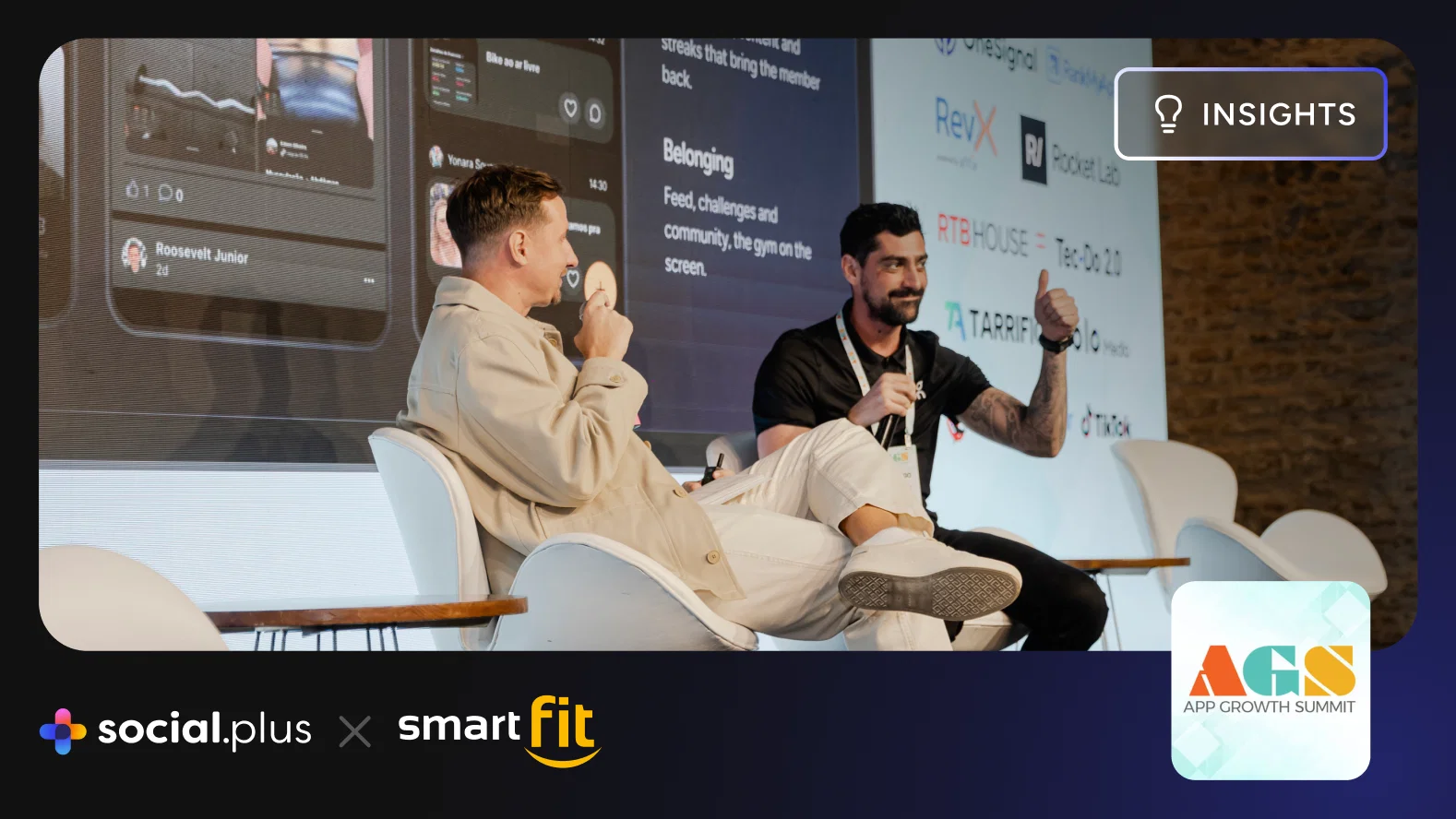
From the Stage: How Smart Fit Uses In App Engagement to Drive Retention

SmartFit is the third-largest gym chain in the world and the largest in Latin America, and it has spent the last few years turning its app into a retention engine rather than a companion to its physical locations. Rodrigo Martins, GM of Products at SmartFit, shared how the company approached in-app engagement in a conversation with social.plus at AGS São Paulo. What SmartFit teaches us about in-app engagement holds lessons for any product team building it into an app.
Why in-app engagement became a retention priority
Rodrigo's starting point was simple: wellness is no longer a trend that needs convincing. Most members already understand that fitness extends past a single workout, into nutrition, body composition, and a broader sense of community. This is a big part of why in-app engagement for fitness apps has become a strategic priority rather than a nice-to-have. The product question SmartFit had to answer wasn't whether to invest in digital experience, but where a member's relationship with the brand should live once they leave the building.
SmartFit's answer was to stop treating the physical gym visit as the entire relationship. Home, work, and the gym had become the three places members spent their time, and SmartFit wanted its app to be part of that third place, not just a companion during workout hours.
Lesson 1: Design engagement around behavior that already exists
Rather than importing features wholesale from consumer social apps, SmartFit's product team started by observing what members already did inside physical locations, an approach grounded in what user engagement is at its core: recognizing existing behavior rather than manufacturing new habits. People get inspired watching others train. They notice regulars. They form informal connections just by showing up consistently. None of that required a digital nudge to exist. It just wasn't captured anywhere.
SmartFit built its engagement layer around that existing behavior instead of manufacturing new habits. Members can post progress updates to an activity feed, track daily streaks, and join groups organized around shared goals. A feature tied to gym check-in lets members connect with others training at the same location and time, turning something that used to pass unnoticed into a real connection. Some of those connections have led to lasting relationships between members, including a Valentine's Day campaign built around the idea.
This is the pattern worth extracting: engagement features work best when they formalize a behavior members are already doing informally, rather than asking them to adopt something unfamiliar.
Lesson 2: Decide deliberately what to build versus what to partner on
Rodrigo was direct about how SmartFit approached the build-versus-partner decision. SmartFit's core expertise is prescribing training programs and helping members reach their fitness goals, not building and maintaining engagement infrastructure. Building that layer internally was possible, but it would have taken time and investment away from the areas where SmartFit's team adds the most value.
Working with a partner let SmartFit launch engagement features while keeping its own team focused on its core business. The lesson generalizes well beyond fitness: in-app community infrastructure and core product expertise are different disciplines, and treating them as separate decisions, rather than assuming one team should own both, tends to get engagement features shipped faster.
Lesson 3: Tie engagement to a real retention metric
Because SmartFit is a public company, Rodrigo was able to share a concrete number: members who actively engage with the app, posting to feeds, joining groups, and interacting with others, return to the app roughly twice as often as members who don't. SmartFit ties that engagement directly to lifetime value, and treats it as a business metric, not just an engagement vanity number.
That distinction matters for any team building a case for engagement investment internally. Rodrigo also pointed out that differentiation through physical assets alone has gotten harder in fitness, since competitors can copy equipment and locations quickly. Features that deepen a member's relationship with the app are much harder to replicate on short notice, which is part of why SmartFit treats engagement as a durable advantage rather than a feature checkbox.
It's worth being specific about what "2x" actually measures here. This isn't app opens or session count in isolation, it's return visits tied to engagement specifically, which is the kind of metric that survives scrutiny in a boardroom. Teams building an internal case for engagement investment should aim for the same specificity: tie participation to a return-visit or lifetime-value metric the business already tracks, rather than inventing a new engagement score that's hard to defend. You can read the full breakdown in SmartFit's full customer story.
Lesson 4: Treat personalization as the next stage, not the starting point
Asked where the category is headed over the next five to ten years, Rodrigo pointed to personalization and a broader definition of health, one that includes biomarkers, longevity, and metrics like VO2 max alongside the traditional workout. He framed it as SmartFit's responsibility to give members access to insight they don't yet know to ask for, in service of long-term outcomes rather than short-term engagement spikes.
The sequencing here is instructive. SmartFit didn't start with hyper-personalized health data. It started with engagement basics, feeds, groups, streaks, proved the retention impact, and only then layered in more ambitious personalization. Teams earlier in their own engagement journey can borrow that order rather than trying to skip straight to the most advanced version.
Final thoughts
SmartFit's results didn't happen from a single launch. Rodrigo's advice to other product teams, echoed during the Q&A at AGS São Paulo, was to identify what's genuinely unmet for users, start with a small experiment, and build consistency before scaling. The retention lift SmartFit now points to is the result of sustained iteration, not a single feature release.
For teams evaluating their own in-app engagement strategy, SmartFit's approach offers a repeatable sequence: observe real user behavior, decide deliberately what to build versus partner on, measure the retention impact honestly, and only then expand into more advanced personalization.
Curious what an in-app engagement strategy could look like for your product? Talk to our team.